
Shop Front Awning Demolition Process Explained
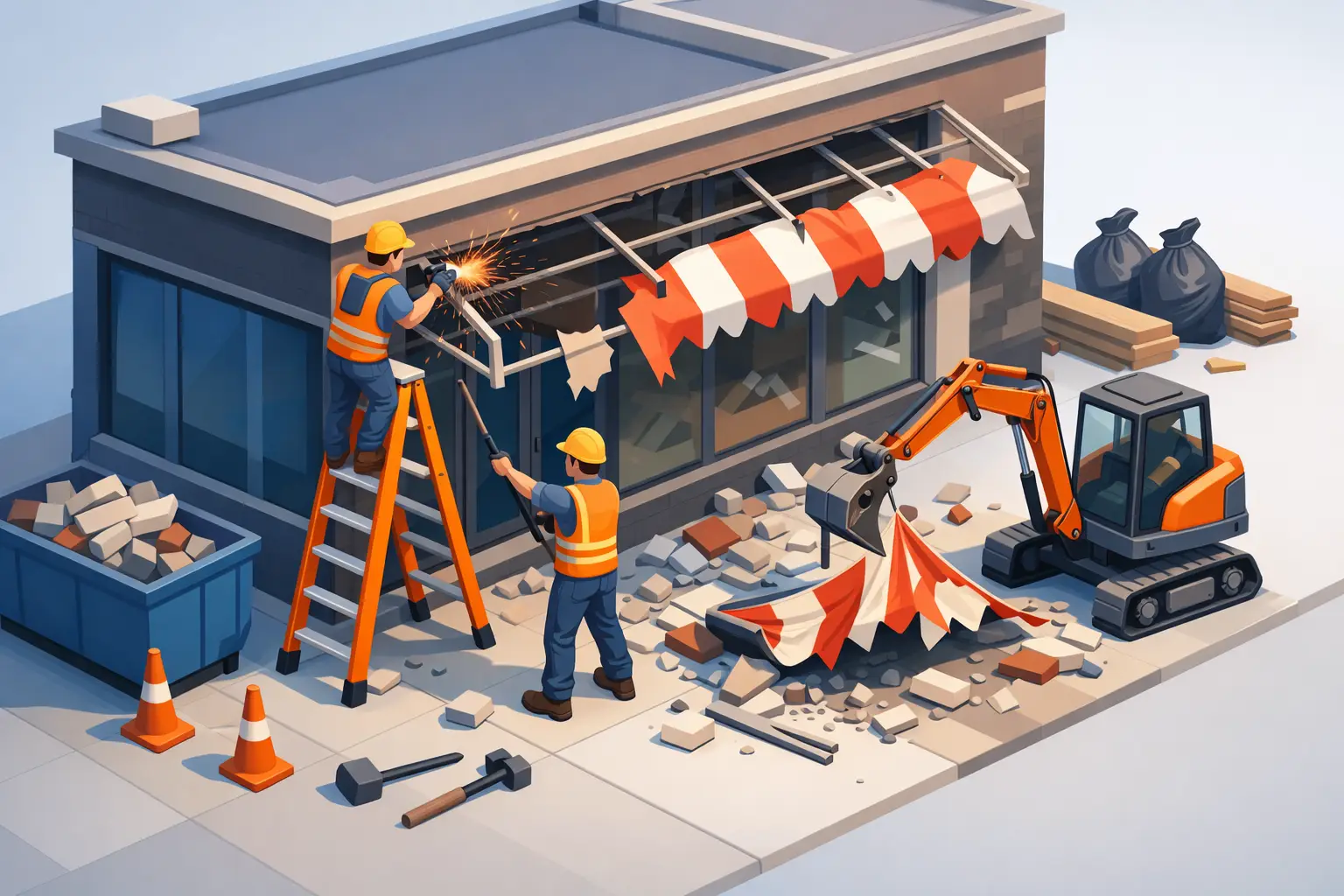
Pulling down a shop awning is not a matter of turning up with tools and ripping into it. When the structure sits over a public footpath, above glazing, wiring, signage or a live tenancy, the shop front awning demolition process needs to be planned properly from the start. If it is handled badly, the risks are obvious - injury to the public, damage to the shop front, delays for other trades, and compliance problems that cost more than the demolition itself.
For most commercial sites, demolition is only one part of a bigger job. The awning may be rusted through, storm-damaged, poorly built, no longer compliant, or simply due for replacement as part of a shopfront upgrade. Whatever the reason, the work has to be done in the right order, with proper controls in place and a clear idea of what stays, what goes, and what happens next.
What the shop front awning demolition process actually involves
A proper demolition process starts well before the first sheet or frame section is removed. The first step is understanding the awning itself - how it is fixed, what materials are involved, how much it weighs, whether it is tied into the building facade, and whether any electrical, drainage or signage components need to be disconnected first.
This matters because no two shop front awnings are exactly the same. Some are light framed structures with sheet cladding and simple brackets. Others are older steel-framed canopies with hidden fixings, layered repairs, water damage and makeshift modifications added over the years. On older sites especially, what looks straightforward from the street can be a different story once the lining or sheeting is opened up.
That is why a site inspection is not a box-ticking exercise. It is where the demolition contractor works out access, lifting needs, public protection, waste removal, and whether parts of the structure need temporary support before dismantling begins.
Site inspection, safety planning and approvals
Before demolition starts, the site needs to be assessed in real conditions. That means looking at the frontage, the footpath, neighbouring tenancies, traffic conditions, overhead services and the condition of the existing awning. If the site is in a busy retail strip or hospitality area, pedestrian management can be just as important as the actual removal work.
In many cases, the awning sits above an active business that still needs access. Sometimes the tenancy can keep trading with the right barricades and staged works. Sometimes it cannot. That depends on the awning size, the removal method and the amount of overhead risk. There is no point pretending every site can stay open as normal.
Approvals may also be needed depending on the scope of work, local council requirements, traffic control needs and whether the demolition forms part of a replacement project. If engineer input is required, it should happen early, not after the structure is half removed and everyone is trying to work around a problem.
A good demolition plan will set out the work area, exclusion zones, sequencing, access equipment, manual handling risks, waste handling and any service disconnections. It should also account for the shopfront below. Protecting glazing, doors, signage and finishes is part of doing the job properly.
Isolating services and preparing the awning for removal
One of the most commonly overlooked parts of the shop front awning demolition process is service isolation. Shop awnings often carry more than people expect. There may be downlights, wiring for signage, security cameras, speakers, conduits, stormwater outlets or patch repairs that have concealed live services.
Before demolition starts, those elements need to be identified and isolated safely. If electricians or other licensed trades are needed, they should be brought in before any cutting or dismantling begins. The same goes for attached signage. If a sign is mounted to the awning frame, it needs to be removed or supported in the right sequence.
Preparation can also include stripping non-structural elements first. Sheeting, fascia panels, light fittings and signage are often removed ahead of the main frame. Doing that reduces weight and gives a better read on how the awning is actually put together.
How the structure is dismantled
Once the site is secure and the awning is prepared, demolition usually moves into staged dismantling rather than full-force removal. That approach gives better control, especially over public areas and fragile shopfronts.
The general rule is simple - reduce loads, maintain stability, and remove components in a sequence that does not create sudden movement. On a typical framed awning, that may mean taking off cladding and linings first, then working back through secondary members, fascia sections, brackets and main supports. On some jobs, sections can be lowered in controlled pieces. On others, the structure needs to be cut down bit by bit because access is tight or the facade below cannot risk impact.
This is where experience counts. Old awnings can be unpredictable. Rust can weaken members that still look serviceable from outside. Previous repairs may have altered load paths. Water ingress can rot timber backing or corrode hidden fixings. If the structure is under tension or partially unsupported, the removal method may need to change on the spot.
That does not mean making it up as you go. It means having a crew that knows how to read the structure as it opens up and adjust safely.
Managing risk over public areas
Street-facing demolition has an extra layer of responsibility because the public is close by. Even with barricades, overhead work above a footpath or shop entry needs proper containment and control. Falling debris, loose sheet metal, tools and dust all need to be managed.
For that reason, a staged closure, overhead protection, spotters or traffic control may be necessary depending on the site. It depends on frontage width, pedestrian flow and how the awning projects over the public realm. A quiet suburban strip and a busy city fringe location are not the same job, even if the awning size is similar.
Waste removal, making good and what happens after demolition
Demolition is not finished when the frame hits the ground. The next part is clearing the material safely, sorting waste streams where required, and leaving the site in a condition that the next trade can actually work with.
Shop front awnings can generate steel, aluminium, sheet metal, timber, signage material, wiring, fixings and general rubbish. Some materials can be recycled. Some cannot. The key point is that waste removal should be planned from the start, especially on tight commercial sites where bins, access and loading zones are limited.
After the awning is removed, the exposed facade often needs attention. There may be old fixing holes, damaged render, corroded brackets, uneven surfaces or waterproofing issues that were hidden behind the canopy. If a new awning is being installed, this is the time to check substrate condition, structural fixing points and final dimensions rather than rushing straight into the next stage.
That handover between demolition and replacement matters. If the demolition team removes the old structure cleanly and identifies any issues early, the new works go smoother. If they leave a mess behind, the replacement programme usually suffers.
Why specialist demolition is worth it
Shop awning demolition looks simple from the street, but it is specialist work. The structure is overhead, exposed to weather, often built in layers over time, and usually sitting above a live commercial frontage. The risks are real, and so are the knock-on costs when it is done poorly.
For property owners, builders and business operators, the value in a proper contractor is not just labour. It is knowing the work will be assessed properly, staged safely, coordinated with other trades, and finished in a way that supports what comes next. That is especially important when the goal is a replacement awning, a tenancy refit or a facade upgrade with tight timing.
Advanced Awnings works on these kinds of commercial frontage projects with a practical focus on safety, workmanship and clean project delivery. That matters because a demolition job is not only about taking something down. It is about protecting the site, the public and the next stage of the build.
If you are planning to remove an existing shop awning, the best starting point is a proper site assessment. Once the structure, risks and access are understood, the right demolition method usually becomes clear.