
9 Best Commercial Canopy Maintenance Tips
A commercial canopy usually starts costing money long before it actually fails. The first signs are easy to miss - a loose bracket, blocked drainage, minor rust at a fixing point, fabric tension starting to drop, or water marks where they should not be. That is why the best commercial canopy maintenance tips are not about fancy products or overcomplicated schedules. They are about regular checks, early repairs and knowing when a small defect is no longer a maintenance issue but a safety risk.
For shopfronts, hospitality venues and other street-facing sites, canopies do more than provide cover. They protect customers at the entry, affect how the premises present from the street and sit in full view of tenants, landlords and the public. If they are neglected, the risks are practical and immediate - water damage, corrosion, damaged signage, trip hazards, loose elements over pedestrian areas and repair costs that climb fast.
Best commercial canopy maintenance tips that matter
The best maintenance plans are simple enough to stick to. If your team only checks the canopy when something starts leaking or rattling, you are already behind. A scheduled inspection routine gives you a much better shot at keeping repair work minor and manageable.
Start with a visual inspection from ground level every month. You are looking for obvious movement, sagging, staining, rust bleed, loose trims, cracked sheeting, damaged fabric, blocked gutters and any sign that fixings are shifting. After storms or strong wind, inspect again. In Sydney and other coastal or exposed locations, weather can speed up wear, particularly on metal components and connections.
A closer inspection should be done periodically by a qualified contractor, especially on older structures or canopies over active public areas. Ground-level checks are useful, but they will not tell you everything about the frame condition, concealed corrosion or the integrity of anchor points.
1. Keep drainage clear
A lot of canopy problems begin with water sitting where it should be moving. Gutters, box gutters, downpipes and drainage channels need to stay clear of leaves, dirt and rubbish. Once water ponds, it adds weight, encourages corrosion and can find its way into adjoining walls, ceilings and shopfront elements.
This is one of the most overlooked issues on commercial premises because the canopy can still look fine from the street. By the time staining or leaks show up inside, the problem has often been there for a while. If your property sits under trees or near busy roads, you may need cleaning more often than your standard maintenance cycle.
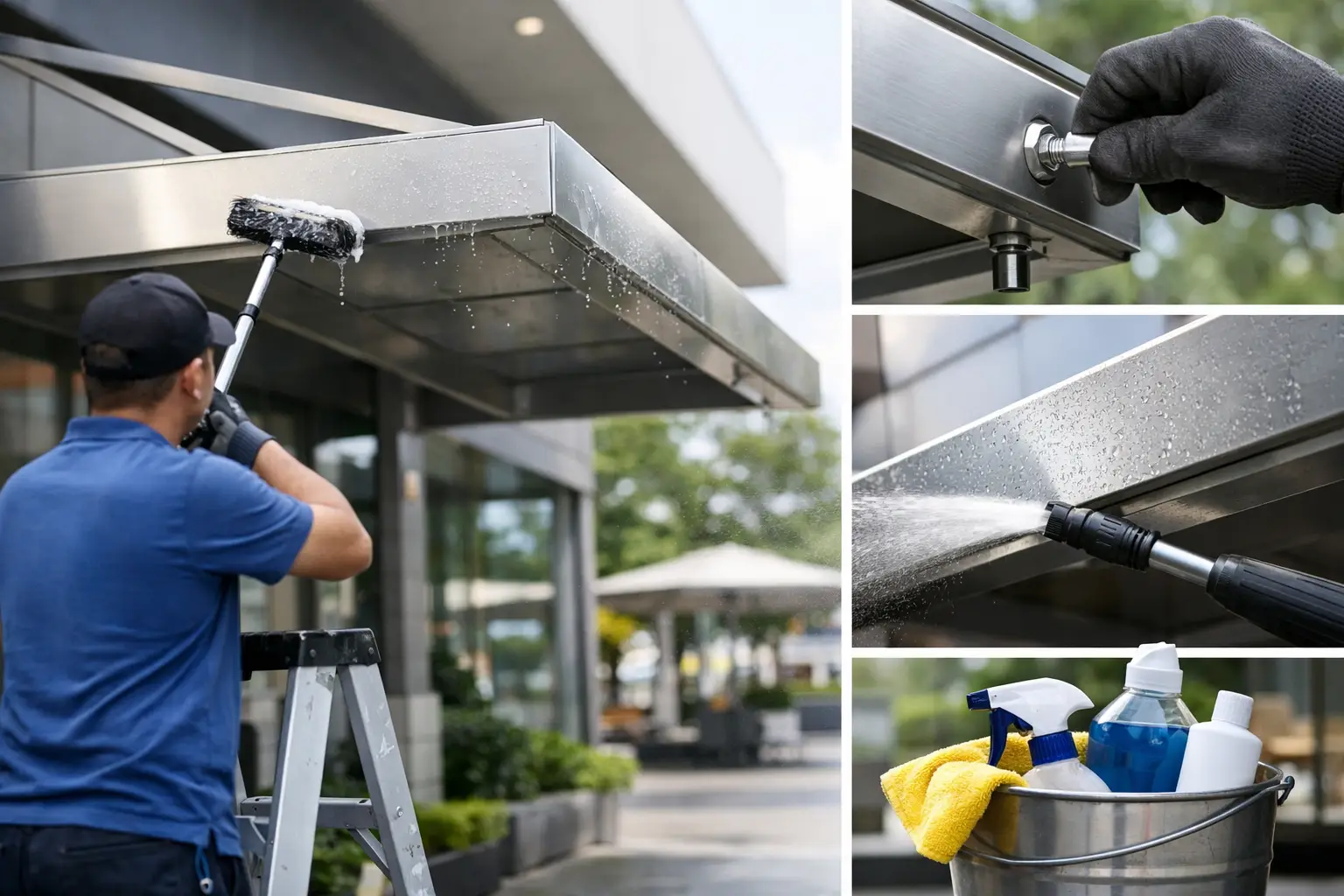
2. Clean the canopy with the material in mind
Not every canopy should be cleaned the same way. Metal awnings, polycarbonate sheets, fabric canopies and painted steel frames all have different tolerances. Harsh chemicals, abrasive pads and high-pressure washing can do more harm than good if used incorrectly.
For routine cleaning, mild detergent, soft brushes and controlled washing methods are generally the safer option. The goal is to remove grime, bird droppings, salt residue and pollution build-up without stripping coatings or damaging seals. On shopfront canopies, appearance matters, but the bigger issue is that trapped contamination can shorten the life of the finish and hide early signs of deterioration.
3. Check rust before it spreads
Small rust spots rarely stay small for long. Surface corrosion around bolts, welds, brackets and joints is one of the clearest warnings that moisture is getting where it should not. On steel-framed canopies, these points deserve close attention because they often carry structural loads.
Light surface rust may be treatable if caught early, but rust that has pitted metal, expanded around fixings or affected connection points needs a proper assessment. This is where property owners sometimes wait too long. A bit of discolouration can turn into section loss, failed fixings or the need for partial replacement. Maintenance is cheaper than reconstruction, but only if it happens early enough.
Inspection points owners and managers should not ignore
Some defects are cosmetic. Others are early safety issues dressed up as minor wear. Knowing the difference matters.
If a canopy is rattling in the wind, visibly sagging, pulling away from the façade, leaking through joints, or showing cracks near supports, do not treat that as routine ageing. The same goes for broken sheet panels, loose fascia sections and damaged underside linings over entrances or footpath-facing areas. In commercial settings, especially where the public passes underneath, a delayed repair can become a liability issue as much as a building one.
4. Watch the fixings and connection points
Bolts, anchors, brackets and welded joins do the hard work, and they are often the first places where trouble starts. Vibration, thermal movement, water ingress and simple age can all affect these components over time.
A canopy may still look straight from a distance while the fixings are starting to loosen or corrode behind trims and flashings. That is why inspections should focus on how the structure is connected to the building, not just the visible face of the awning. If there is any movement at the connection point, get it checked properly.
5. Do not ignore minor fabric or sheet damage
A small tear in fabric, a cracked polycarbonate section or a lifting edge trim can seem harmless, especially if there is no leak yet. But wind gets under damaged areas quickly. Once that happens, the defect usually grows faster than expected.
Replacing a single section or carrying out a contained repair is normally far simpler than dealing with a larger failure after the next storm. This is one of those areas where a quick response saves both time and presentation. For hospitality venues and retailers, that visible wear can also affect customer perception long before it becomes a major defect.
6. Look at the surrounding building elements
Canopy maintenance is not just about the canopy itself. Adjacent wall cladding, sealants, signage, glazing junctions and drainage discharge points all affect how the structure performs. Water entry at the wall connection, for example, may show up as an internal leak that looks like a roofing issue when the real problem sits at the interface between canopy and façade.
That is why experienced contractors assess the whole area, not just one damaged panel. The fault you can see is not always the fault causing the problem.
Best commercial canopy maintenance tips for longer service life
If the goal is to get more years out of the canopy without compromising safety or presentation, consistency beats reactive spending. A neglected canopy usually becomes expensive in stages: cleaning gets skipped, a leak appears, a patch repair gets done, corrosion continues behind the scenes, then replacement becomes the only sensible option.
Planned maintenance breaks that cycle. It gives you a record of condition, helps with budgeting and reduces the chance of emergency call-outs. For landlords and property managers, it also makes contractor advice easier to act on because you are looking at an ongoing history instead of a once-off surprise.
7. Keep a basic maintenance record
This does not need to be elaborate. A simple log of inspection dates, noted defects, photos and completed repairs is enough to be useful. It helps track recurring issues, shows whether damage is worsening and gives contractors clearer information when they attend site.
For multi-tenant or managed properties, this record also helps avoid the usual confusion over who noticed what and when. If there is a dispute about deterioration or responsibility, clear records are always better than memory.
8. Use qualified repairers for structural issues
There is a place for routine cleaning and basic site checks, but structural repairs are not a handyman job when the canopy projects over entrances, seating areas or public access paths. Once the issue involves anchors, steelwork, framing, demolition of damaged sections or any question around compliance, use a specialist.
The trade-off is straightforward. A cheaper short-term fix may save money this month, but if it fails, you can end up paying for make-safe works, further damage and a proper repair anyway. On some sites, engineer input or certification support may also be needed, particularly where sections are being replaced or structural integrity is in question.
9. Know when maintenance is no longer enough
Not every ageing canopy should be endlessly patched. If the frame has widespread corrosion, repeated leaks, poor previous repairs, or visible movement, replacement may be the more practical and safer decision. The same applies where the structure no longer suits the tenancy, fails to present well from the street or creates ongoing compliance concerns.
Good advice here should be honest. Sometimes a repair is the right call. Sometimes demolition and replacement is the cleaner, safer option. What matters is getting a realistic assessment based on condition, not wishful thinking.
Commercial canopies work hard in the background, and most owners only think about them when something goes wrong. A better approach is to treat maintenance as part of protecting the building, the business frontage and the people underneath it. If you stay on top of the small issues, you give yourself more options when the bigger decisions eventually come around.