Shop Canopy vs Awning: Which Suits Your Frontage?
A street-front cover has to do more than keep rain off the door. It needs to protect customers at the entry, suit the building, carry signage where required and stand up to years of sun, wind and daily exposure. When weighing up a shop canopy vs awning, the right choice comes down to the site, the level of cover needed and the condition of the structure behind it.
For Sydney shop owners, landlords and builders, this is rarely a purely cosmetic decision. A poorly supported cover, leaking sheet, corroded frame or damaged fascia can affect safety, presentation and day-to-day trade. Getting the scope right before work starts saves costly changes later.
Shop canopy vs awning: the practical difference
The terms are often used interchangeably, but they can describe different types of work.
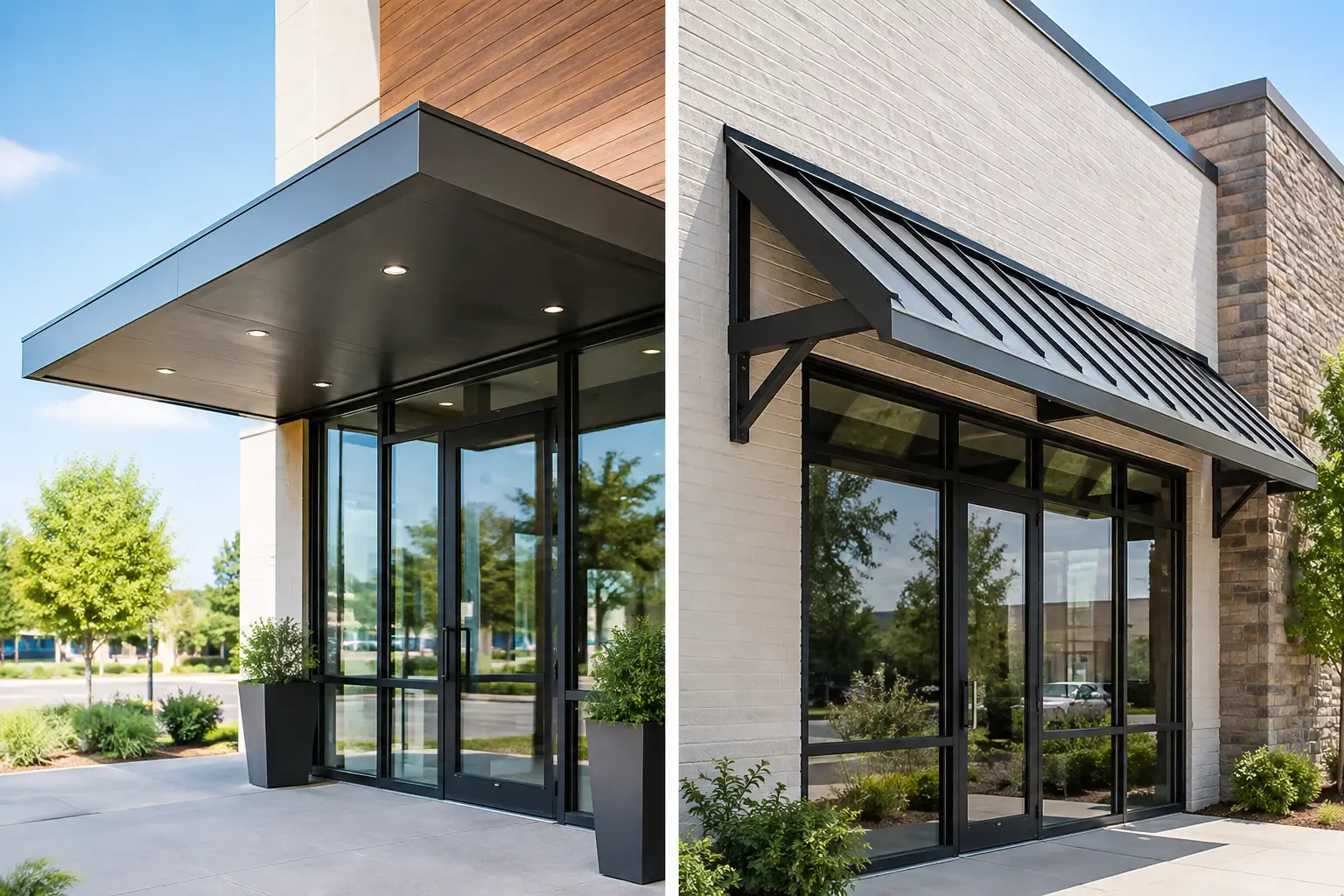
A shop awning is generally a projecting structure fixed to the building above the shopfront. It provides cover over the footpath-facing entry, windows or outdoor seating area. Traditional fixed shopfront awnings are commonly built from steel framing with roof sheeting, cladding, gutters and a fascia suitable for signage. Retractable fabric awnings are also available, although they serve a different purpose and have different maintenance needs.
A canopy is usually a more defined shelter over a doorway, loading point, walkway or outdoor area. It may be smaller than a full-width awning, supported by brackets, posts or columns, and designed around a particular entrance. In commercial settings, a canopy can also refer to a larger freestanding or attached structure that creates covered space beyond the building line.
The distinction matters because the support method, drainage, engineering requirements and construction process can be quite different. A narrow entrance canopy may be the sensible answer where only the doorway needs protection. A full shopfront awning is often better where customers queue, browse windows or move along an exposed frontage.
Start with what the frontage needs to do
The best option is the one that solves an operational problem, not simply the one that looks good in a brochure. Consider where people stand during rain, whether the entrance gets harsh afternoon sun, and whether stock, menus or displays are affected by weather. A cafe with outdoor tables may need broad, consistent coverage. A professional office with a recessed doorway may only require a compact canopy over the entry.
Look at the whole frontage as well. If the existing awning spans several tenancies, replacing only one section may create drainage, flashing or visual issues at the joins. If a building has limited fixing points or ageing masonry, a new canopy may need a different support arrangement. These are site-specific matters that should be inspected properly before a quote is finalised.
For landlords and property managers, consistency is often a factor. A durable, well-finished fixed awning can give multiple tenancies a cleaner presentation while reducing exposure at the front of the building. For a single retailer, a smaller canopy may provide the required cover without overwhelming the facade.
Fixed awnings suit permanent commercial cover
A fixed shopfront awning is built for premises that need reliable protection every day. It suits retail strips, hospitality venues, medical practices and commercial entries where the footpath edge is part of the customer experience.
Because it is permanent, the design can incorporate practical details that make a difference over time: adequate fall for water run-off, gutters and downpipes, flashings at the wall connection, strong fascia lines and materials that suit the building. It can also provide a stable location for shop signage, subject to the relevant requirements.
The trade-off is that fixed structures require proper planning and installation. Existing conditions need checking, particularly where there is corrosion, water damage, old timber, loose cladding or evidence that a previous awning has moved. Simply fixing new material over a failing frame is not a long-term repair.
A full replacement may involve safe removal of the old structure, assessment of the supporting wall, new framing and roofing, drainage work, cladding, painting and making good the affected facade. On a busy street, the work also needs to be managed around pedestrians, neighbouring businesses and site access.
When a fixed awning makes sense
Choose a fixed awning when weather protection is required across most or all of the frontage, when signage needs a permanent fascia, or when the building needs a strong visual line that complements other tenancies. It is usually the more practical option for a high-traffic shopfront that cannot rely on staff extending and retracting a system each day.
It can cost more upfront than a small entry canopy, particularly where demolition or structural repairs are required. However, a properly built fixed awning is designed as part of the premises rather than as an add-on.
Canopies work well for targeted protection
A canopy is often the better choice where the goal is clear and contained: cover the main entry, shelter a side door, protect a service window or create a dry transition from the kerbside to the building.
This approach can preserve more of the facade and avoid installing a full-width structure where it is not needed. For modern commercial buildings, a simple metal canopy can provide a sharp, functional finish without changing the character of the entire frontage.
Support is the key issue. Some canopies are bracketed back to the building, while others use posts at the outer edge. Posts can provide strength, but they need to be positioned carefully so they do not obstruct access, interfere with footpath use or create a hazard. Bracketed canopies keep the ground clear but place more demand on the wall and its fixings.
Water management still matters. A small canopy that directs runoff straight over an entrance or towards a pedestrian path is not doing its job. The design needs sufficient fall and a sensible drainage path, particularly on sites exposed to wind-driven rain.
When a canopy is the better fit
A canopy is often suitable for a defined entrance, a building with a narrow frontage, or a site where a larger awning is not practical. It can also be useful when an existing full-width awning has reached the end of its life but the property owner wants to reduce the overall footprint of the replacement.
That does not automatically make it the cheaper option. Complex brackets, custom fabrication, difficult access and structural work can increase the cost of a small canopy. The size of the job is only one part of the pricing.
Approval, engineering and public safety cannot be an afterthought
Any structure projecting from a commercial building needs to be considered carefully, especially where it sits above an active footpath. Depending on the property, location and proposed work, approvals, certification or engineering may be required. Existing structures can also reveal issues once cladding is removed, including rusted steel, failed fixings or deteriorated connections.
A competent contractor should assess the work in practical terms before promising a result. That includes access for demolition and installation, protecting the public below, isolating the work zone where necessary and handling removed materials safely. On occupied premises, sequencing also matters. A retailer may need the entry kept accessible, while a restaurant may need noisy work completed outside service periods.
Engineer certification support is particularly valuable where a new structure has significant loads, unusual spans, altered supports or a questionable existing substrate. It gives owners and project managers a clearer path from design through to installation.
Compare maintenance before making a decision
No external structure is maintenance-free. Fixed steel awnings should be checked for corrosion, failed sealants, loose sheets, blocked gutters, paint breakdown and water staining around flashings. Catching these issues early is generally far less disruptive than waiting for a leak to damage the shopfront or for rust to spread through a frame.
Canopies need the same attention, particularly at wall connections and brackets. Their smaller size does not remove the risk of water ingress or movement. Retractable systems have additional moving parts and fabric to maintain, so they may suit seasonal shade but are not always the best answer for permanent wet-weather cover.
When assessing an older installation, ask whether repair is genuinely worthwhile. Localised rust, damaged sheeting or a failed gutter may be repairable. Widespread corrosion, recurring leaks or movement in the frame may point to replacement as the safer and more economical long-term option.
Choose the contractor around the real scope
The right decision is not simply canopy or awning. It is whether the proposed structure is properly designed for the frontage, securely supported, drained correctly and finished to a standard that reflects the business behind it.
Advanced Awnings works with commercial clients on shopfront awning installation, repair, replacement and safe demolition across Greater Sydney. A site inspection and clear quote should identify what is sound, what needs attention and what work is required to deliver a safe, clean result.
Before committing, stand outside the premises during the conditions that cause the problem - heavy rain, strong sun or a busy trading period. The cover that works on that day is the one worth building.