How to Repair Leaking Awnings Properly
A leaking awning usually shows up at the worst time - during trading hours, over a busy entry, or right after a bit of rain turns into a proper downpour. If you are looking into how to repair leaking awnings, the first thing to know is this: the visible drip is not always where the problem starts. On commercial sites, water can travel along frames, sheeting, joints and fixings before it finally shows itself at the front edge.
That matters because a quick patch in the wrong spot wastes time and money. In some cases, it also leaves a safety issue sitting over a public walkway, shopfront or outdoor dining area. A proper repair starts with finding the actual entry point, checking whether the awning is still structurally sound, and choosing a fix that suits the material and the way the awning was built.
How to repair leaking awnings without guessing
The main mistake people make is treating every leak like a sealant problem. Sometimes it is. Often it is not. A commercial awning can leak because of split seams, failed flashing, loose fixings, rusted sheet laps, blocked drainage points, movement in the frame, or damage where the awning ties back into the building.
Start with a close visual inspection when the awning is dry and safe to access. Look for staining, rust marks, cracked sealant, lifted joints, loose screws, pinholes in metal sheeting, and any area where water could pond instead of draining off. Check the wall connection carefully. On shop front awnings, leaks commonly start where the canopy meets the façade, then track outward through the structure.
If the underside is lined, the leak may be hidden above the ceiling panel. In that case, water staining underneath only tells you where it ended up, not where it got in. That is why leak tracing often needs a methodical approach rather than a tube of sealant and a ladder.
Check whether it is a repair job or a replacement job
This is where experience matters. If the awning has localised issues - a failed joint, a few damaged fixings, minor corrosion, or isolated flashing defects - repair is often the right call. If the frame has widespread rust, visible sagging, rotten substrate, recurring movement, or long sections of failed sheeting, patching it may only buy a short amount of time.
For commercial properties, there is also the public safety side. If water ingress has weakened connections or caused sheet edges to lift, the problem is no longer just about keeping rain out. It becomes a maintenance and compliance issue. A repair has to be stable, weather-tight and fit for a public-facing environment.
The most common causes of awning leaks
On older shop front awnings, failed flashing is one of the biggest culprits. If the flashing has lifted, corroded, or was never properly chased into the wall, water can get behind it and run into the awning cavity. Surface sealant might slow that down for a while, but it will not fix a badly formed flashing detail.
Fixings are another common issue. Screws can loosen over time, especially on awnings exposed to wind, vibration and heat movement. Once the washer fails or the fixing hole opens up, water can enter around the screw. If the surrounding sheet is thin with rust, simply tightening the screw can make the problem worse.
Poor falls and blocked drainage also cause trouble. If water sits on the awning instead of running off cleanly, it will eventually find a way through laps, penetrations or weak points. On some canopies, leaves, rubbish and debris build up near the wall line and hold moisture where it should not be.
Then there is movement. Commercial awnings expand and contract. If different materials have been joined poorly, or the original work did not allow for movement, sealants and joints can fail earlier than expected. That is one reason repeat leaks keep coming back after DIY patch jobs.
What a proper repair usually involves
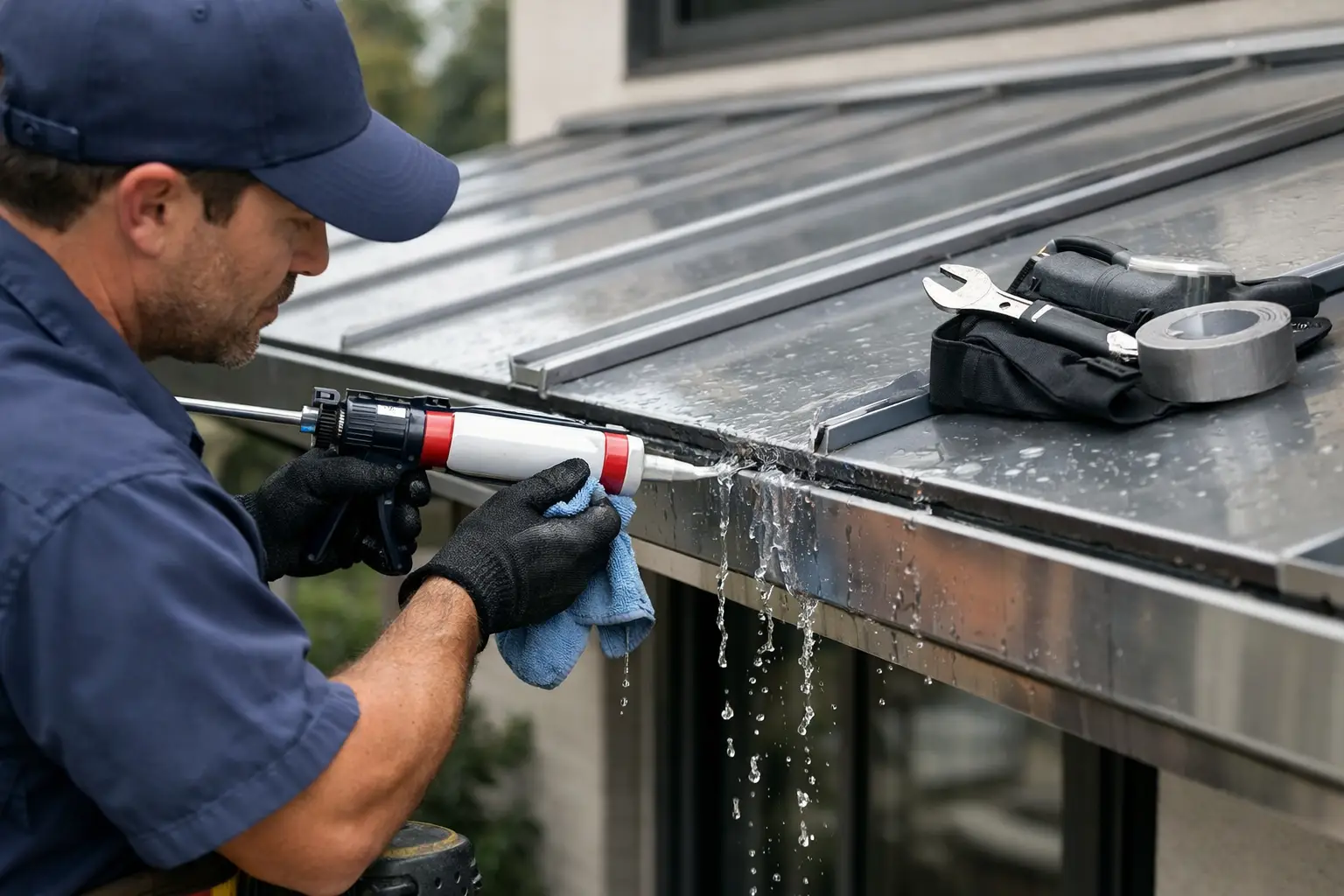
The right repair depends on the cause. If the leak is coming through failed sealant at a stable joint, the old material should be removed, the surface cleaned properly, and a suitable exterior-grade sealant applied to the correct detail. Smearing new sealant over dirt, rust or old cracked product is rarely worth doing.
If the issue is around fixings, damaged screws and washers should be replaced with compatible fixings, and any enlarged holes dealt with properly. In some cases that means refastening into sound material. In others, the affected sheet section needs to be replaced.
Where flashing has failed, the best repair is often to remove and refit or replace the flashing rather than trying to seal over the top of it. A properly formed flashing detail directs water away from the joint. Sealant on its own is not a substitute for that.
For metal awnings with local corrosion, treatment depends on how far the rust has gone. Light surface corrosion may be cleaned back and protected. Perforated metal, rusted laps, or corroded structural sections usually call for section replacement. Once metal has lost thickness, it cannot be made sound again with coatings alone.
Fabric awnings are a different story. Small splits or seam failures may be repairable, but if the fabric has become brittle, shrunken or generally worn out, patching tends to be short-lived. The same goes for membrane-style covers where water entry is caused by tension loss or failed edge detailing.
Why temporary fixes often fail
There is nothing wrong with an emergency make-safe if water is entering a tenanted shop or dripping over a doorway. The problem starts when a temporary fix gets treated like a finished repair. Roofing tape, surface silicone and ad hoc patches can be useful to reduce immediate water entry, but they often hide the defect and make proper repair harder later.
Commercial awnings take weather, movement and UV exposure every day. If the repair material is not suited to the substrate, or if the detail is wrong, the leak usually returns with the next heavy rain. Worse again, trapped moisture can keep working away inside the awning while the outside looks patched up.
Safety comes first on commercial awnings
Anyone searching how to repair leaking awnings should be realistic about access and risk. A small awning over a private yard is one thing. A shop front canopy over a footpath, loading area or customer entrance is another. Working at height, near glazing, over public space, or on a corroded structure carries real risk.
If there is visible rust, loose sheeting, sagging, damaged framing or signs the awning may not be stable, do not treat it as a simple maintenance job. The same applies if repairs involve removing sheet sections, flashings or structural components. At that point you are into specialist work, and in some cases engineering input may be needed, especially on larger commercial canopies.
For landlords, property managers and business owners, the practical question is not just can this be patched. It is whether the repair can be done safely, neatly and in a way that holds up under use and weather.
When to call in a specialist
The line is fairly clear. If the leak is minor, the awning is in otherwise good condition, access is safe, and the source is obvious, a straightforward repair may be enough. But if the leak keeps returning, the source is unclear, or the awning shows signs of corrosion, movement or age-related failure, specialist assessment is the smarter move.
That is especially true for street-facing commercial awnings, where appearance matters nearly as much as weather protection. A repair should not leave mismatched sections, messy sealant lines or visible patchwork over the front of the premises. It needs to look right and perform properly.
This is where a contractor with actual shop front awning experience makes a difference. The job is not only to stop the leak. It is to understand the build-up, protect the public area below, repair the detail properly and flag any wider issues before they become more expensive.
Advanced Awnings handles this kind of work with that practical mindset - repair what can be repaired, replace what is no longer sound, and do it in a way that suits an active commercial site.
A better way to think about awning leaks
The best repairs are not rushed, and they are not based on guesswork. Water ingress in an awning is usually a sign that one part of the weatherproofing system has failed, and sometimes that points to bigger wear in the surrounding materials. If you catch it early, the job may stay relatively contained. If you leave it, a simple leak can turn into corrosion, internal damage, signage issues, ceiling damage or a hazard over the entry.
A good repair is one that solves the cause, not just the symptom. If your awning is leaking, start with a proper inspection, be honest about the condition of the structure, and do not settle for a patch that only lasts until the next storm.