How to Replace Rusted Canopies Properly
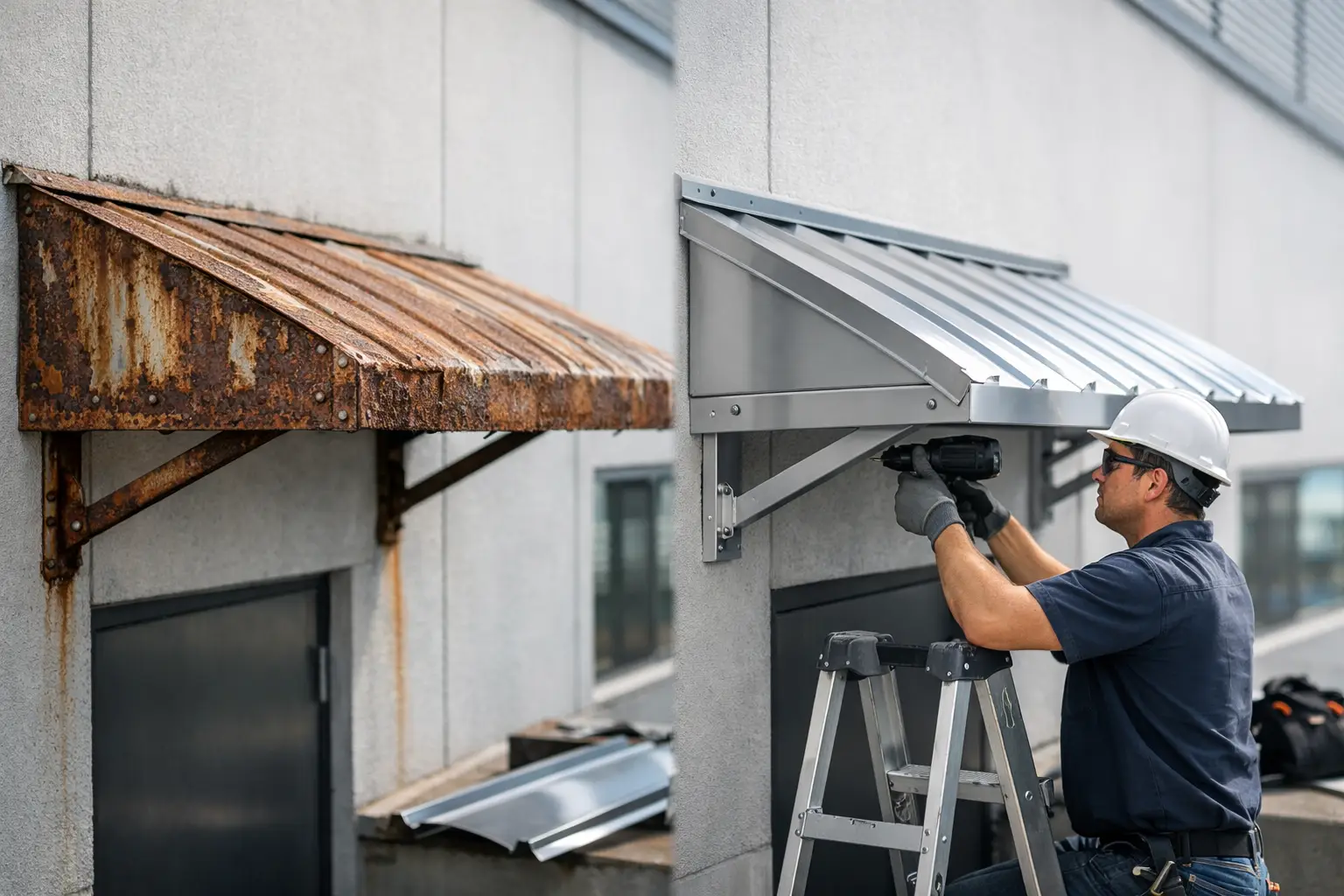
A rusted canopy rarely fails all at once. It starts with bubbling paint, stained fixings, swollen joints and sections that no longer sit straight. If you are looking into how to replace rusted canopies, the main issue is not appearance alone. On a commercial frontage, corrosion can turn into a public safety problem, water ingress issue and compliance risk very quickly.
For shop owners, landlords and property managers, the right approach is usually not to patch over the worst section and hope for the best. A proper replacement starts with understanding what has actually failed, what can stay, and what needs to be removed and rebuilt so the finished canopy is safe, presentable and built for daily exposure.
How to replace rusted canopies without creating bigger problems
The first step is not fabrication. It is inspection. Rust on the visible face of a canopy can be the least of the problem. Water often gets into connections, support members, fascias and sheet joins long before the damage becomes obvious from the street. What looks like a simple metal skin replacement can turn out to involve structural steel, failed brackets or rotten fixings behind cladding.
That is why a proper site assessment matters. You need to establish whether the canopy is suffering from surface corrosion, localised failure or broader structural deterioration. If the rust is limited to a small non-structural element, repair may still be possible. If the corrosion has spread into supports, anchor points or framing, replacement is usually the safer and more cost-effective call.
For commercial sites, there is also the issue of the public area below. A rusted shopfront canopy sits over entries, footpaths, outdoor seating or loading zones. Once deterioration reaches a certain point, delays can expose owners and occupiers to unnecessary risk. The right contractor will treat this as a live site issue, not just a metalwork job.
When replacement makes more sense than repair
Some clients understandably ask whether they can save money by repairing sections instead of replacing the whole canopy. Sometimes they can. Sometimes they end up paying twice.
Repair tends to make sense when the canopy frame is still sound, the corrosion is isolated, and replacement parts can be integrated cleanly without leaving a patchwork finish. This can work on younger structures or canopies that have suffered from one local leak rather than years of exposure.
Replacement is usually the better option when rust has spread across multiple sections, when water has been getting in for a long time, when the canopy is visibly sagging or separating, or when previous repairs have already failed. The same goes for old shopfront awnings where the existing build does not meet current expectations for finish, drainage or structural confidence.
There is also a practical business decision to make. A piecemeal repair may look cheaper on paper, but if it leaves old material beside new material, more maintenance often follows. For many commercial owners, a full replacement gives a cleaner result, fewer call-backs and a frontage that actually improves the building rather than merely holding it together.
What the replacement process usually involves
Every site is different, but the process is generally straightforward when it is handled properly.
1. Site inspection and scope
The canopy is inspected for visible corrosion, structural movement, water damage and fixing condition. Access issues, foot traffic, neighbouring tenancies and trading hours also need to be considered. On active commercial sites, the safest job is the one that has been planned around the way the premises actually operates.
At this stage, measurements are taken and the replacement scope is defined. That may involve full demolition and new installation, or selective retention of sound structural elements if they are still suitable.
2. Demolition and safe removal
Removing a rusted canopy is not a matter of undoing a few bolts and dropping sections onto a ute. Old awnings can be unstable, especially once corroded sheeting or framing begins to come apart. Safe demolition needs controlled sequencing, proper exclusion zones and care around glazing, signage, wiring and pedestrian access.
For street-facing shops, this part matters as much as the new build. A tidy finished awning means very little if the demolition phase creates avoidable risk or damage.
3. Fabrication and material selection
The replacement canopy should be built to suit the site, not forced into a generic shape that almost works. Material choice depends on the frontage, exposure level, drainage requirements and desired finish. In some cases, heavier-duty steel framing is needed. In others, aluminium components or new sheet systems can improve service life and reduce ongoing maintenance.
This is also where practical design decisions count. Better water runoff, cleaner fascia lines, stronger fixings and proper flashing details often make the difference between a canopy that lasts and one that starts showing trouble again too soon.
4. Installation and finishing
Once the new canopy is ready, installation should be carried out with the same focus on safety and fit. The frame needs to sit true, connections need to be secure and finishes need to hold up both visually and structurally. Commercial clients are not just paying for cover over a doorway. They are paying for a frontage that looks professional and performs properly.
Depending on the project, engineer certification may also be required. On many commercial jobs, that support is not optional. It is part of getting the work done properly and giving owners confidence in what has been installed.
Materials matter, but workmanship matters more
A common mistake is assuming rust problems are solved by choosing a better metal and nothing else. Better materials help, but poor detailing will still create failure points.
If water sits in joins, if edges are left exposed, if coatings are damaged during installation, or if fixings are mismatched to the environment, corrosion can return earlier than expected. Coastal exposure, heavy rain, traffic grime and lack of maintenance all add pressure to the system.
That is why commercial canopy replacement should be approached as a full construction job, not just a fabrication order. The finish has to look right, but the hidden parts need equal attention. Drainage, fall, sealing, connections and fixing integrity are what keep the new canopy performing after handover.
Budget, downtime and what affects the cost
Owners usually want a straight answer on cost, and fair enough. The price to replace a rusted canopy depends on the size of the structure, the extent of demolition, access conditions, traffic management needs, material choice and whether any structural or certification work is required.
A simple replacement on an accessible frontage is a different job to a deteriorated awning above a busy shop entry with restricted access and multiple tenancy interfaces. The cheapest quote is not always the cheapest outcome if it leaves out safe demolition planning, proper materials or a compliant finish.
Downtime also depends on the site. Some jobs can be staged around trading hours. Others need partial closures to manage risk properly. Good planning reduces disruption, but on a live commercial frontage, safety has to come first.
How to choose the right contractor for rusted canopy replacement
If you are comparing contractors, ask direct questions. Have they handled commercial awning demolition before? Do they understand active street-front sites? Can they manage replacement from inspection through to install? Are they properly insured? Can they assist with engineering requirements where needed?
This is specialist work. A rusted canopy over a public-facing business is not the place for guesswork or vague promises. You want a contractor who can identify what has failed, explain the options plainly, and carry the job through without creating unnecessary risk or mess.
In Sydney, that often means dealing with ageing shopfront structures exposed to years of weather, poor drainage and ad hoc past repairs. Advanced Awnings works on exactly that type of replacement - practical commercial canopy jobs where safety, finish and proper installation all matter.
Preventing the same problem from coming back
Once a new canopy is installed, a small amount of maintenance goes a long way. Keep drainage points clear, deal with coating damage early, inspect joints and fixings periodically, and do not ignore small leaks. Surface rust is much cheaper to address than structural corrosion hidden behind a fascia.
If your existing canopy is showing stains, flaking paint, swelling metal or visible movement, it is worth getting it looked at before the damage spreads. The best replacement jobs are usually the ones done before the canopy reaches the point of failure.
A rusted canopy does not fix itself, and patching over it rarely saves money for long. Getting the structure assessed early, and replacing it properly when the time comes, gives you a safer frontage, a better finish and one less problem hanging over your entry.