Public Safety During Awning Works in Sydney
A shop front awning sits directly above the place people walk, queue, park and enter. That is why public safety during awning works cannot be treated as a quick barrier around a work crew. Whether an awning is being repaired, removed or replaced, the job needs to protect pedestrians, neighbouring tenants, customers, traffic and the people doing the work.
For commercial properties, the safest result starts before anyone arrives with tools. A clear plan, the right access method and proper site control prevent small disruptions from turning into damage, injury or an avoidable shutdown.
Start with the condition of the awning
No two awnings come down or go up the same way. A light fascia repair above a sheltered arcade is a very different job from demolishing a corroded steel shop front awning over a busy footpath. The structure may contain hidden rust, loose sheeting, deteriorated fixings, old electrical cabling or sections that have already started to fail.
A proper site inspection identifies what is supporting the awning, how it is fixed to the building and whether it can safely carry workers or equipment. It also considers what is below and beside the work area. A narrow footpath outside a café, a bus stop near the frontage or a shared entrance can change the entire approach.
Where the awning is structurally unsound, work should not begin with people standing underneath it while deciding what to do. The area needs to be isolated first. An engineer's assessment or certification may also be needed, particularly where a new awning is being designed, substantial structural repairs are required, or existing supports are being altered.
Plan public safety during awning works before site set-up
The public does not know where the risks are. They will naturally take the shortest route to a shop entrance, look at their mobile while walking, or move around a barrier if it appears to block access without explanation. Site controls must account for normal behaviour, not rely on passers-by making perfect decisions.
Before work starts, the contractor and property representative should agree on the work zone, entry arrangements, delivery timing and the likely impact on trading. On a street-facing site, this may involve a temporary pedestrian diversion, a protected walkway, traffic management or permits for occupying part of the footpath. Requirements vary according to the location, council conditions and the nature of the work.
The plan should also identify emergency access, loading areas and neighbouring businesses. Blocking a fire exit, a medical access point or another tenant's doorway is not an acceptable trade-off for getting the job done faster. If a safe route cannot be maintained during a high-risk stage, that stage may need to be scheduled outside trading hours or when pedestrian traffic is lowest.
Choose access equipment for the actual site
Scaffolding, elevated work platforms and ladders all have a place, but they are not interchangeable. The right choice depends on the height, reach, ground conditions, task duration and the level of public exposure.
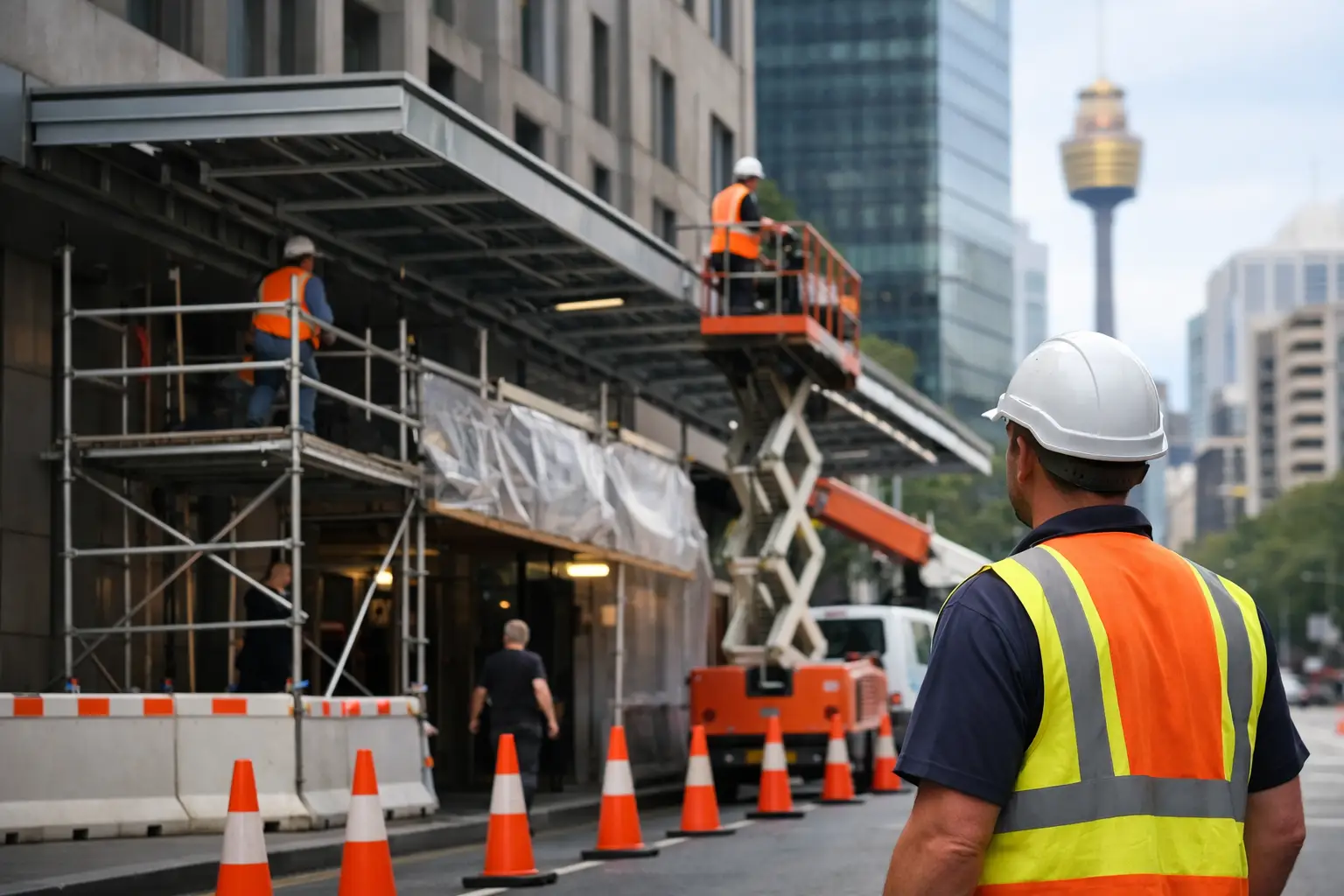
A ladder may be suitable for a short, low-risk inspection. It is generally not the right answer for extended demolition or heavy installation work above a public path. Scaffolding can provide a stable working platform and overhead protection, but it needs to be designed, installed and controlled correctly. An elevated work platform may reduce time at height in some locations, although it requires safe positioning, exclusion zones and consideration of pedestrians and nearby vehicles.
The cheapest access option is not always the safest or most efficient. Stopping a job halfway because the crew cannot safely reach a fixing, or because the public route has not been protected, costs more than planning the right set-up from the start.
Separate people from the work zone
Physical separation is the backbone of safe public-facing awning work. Cones and tape may be useful for directing people around a small, low-risk task, but they do not stop someone walking into a demolition area or underneath overhead work. Strong barriers, clear exclusion zones and controlled access are needed where there is a risk of falling materials, moving equipment or tools being used overhead.
The work area should be large enough to account for the actual hazard, not just the footprint of the crew. During removal, sheets, brackets, bolts and small fragments can fall or be blown beyond the edge of the awning. A protected zone must extend far enough to keep pedestrians clear, with barriers checked regularly rather than left unattended all day.
Signage should be simple and visible. It needs to tell people where to go, not merely tell them they cannot proceed. If a route changes, provide a safe alternative with enough clearance for prams, mobility aids and deliveries where practical. Poorly placed barriers can create their own hazard by forcing pedestrians into a driveway, cycle lane or traffic lane.
A spotter or site representative is especially useful during deliveries, lifting, platform movements and any period when the exclusion zone changes. Their role is active. They watch the public interface, stop movement when required and make sure a customer or delivery driver does not wander into danger.
Control falling-object risks properly
Most public risk around awning works comes from what is overhead. Loose fasteners, drill dust, broken cladding and sections of old timber or steel can cause harm even when they seem minor from ground level.
Tools and materials should be secured where there is a risk of dropping them. Components should be removed in a controlled sequence, not pulled apart in a way that leaves unsupported sections hanging above the footpath. Larger items may need lifting equipment or a planned manual handling method so they can be lowered safely rather than dropped into a skip or onto the ground.
Demolition needs particular care. Old awnings often hide the true condition of their frame until cladding is removed. Corrosion around brackets or wall connections can mean a section behaves differently from what is expected. The crew should work to a planned sequence, keep people out of the drop zone and stop if the structure shows unexpected movement.
Rubbish removal also matters. Offcuts, sharp metal and packaging should not build up around entrances or pedestrian routes. Keeping the site tidy reduces trip hazards and gives workers a clearer view of the area they are controlling.
Keep tenants, customers and neighbours informed
Good communication is a practical safety control. Property managers and business owners should know when noisy work, access restrictions or deliveries are expected. Nearby tenants need enough notice to adjust customer access, outdoor dining, stock deliveries or staff parking.
For works at an active retail or hospitality site, the safest arrangement may be staged. One section can be completed while another entrance remains available, provided the separation is genuine and the work does not create overhead risk near the operating area. In other cases, a short closure is the better option. It depends on the awning condition, the public space available and what the work involves.
Clear communication also helps manage unexpected changes. Rain, high winds, hidden damage or a delayed delivery can affect the schedule. If conditions change, the site controls must change with them. Leaving a partially removed awning, unsecured materials or an incomplete barrier arrangement overnight is not a workable solution.
Weather and traffic can change the risk quickly
Sydney weather can turn a straightforward external job into a higher-risk one. Wind can catch long sheets of metal or fabric. Rain can make access equipment slippery and reduce visibility. Heat can affect worker concentration, particularly during roof-level work or demolition in direct sun.
Traffic is another variable. A site beside a busy road, laneway or loading bay needs controls that account for vehicles as well as pedestrians. Deliveries should be timed and managed so workers are not carrying awning sections across an active vehicle path without separation.
A professional crew reassesses conditions throughout the day. Stopping work when wind increases or a pedestrian surge makes the site unsafe is not lost time. It is part of doing the work properly.
Choose a contractor who treats safety as part of the build
A finished awning should look sharp, drain correctly and stand up to commercial use. But workmanship includes everything that happens before the final sheet or fascia goes on. It includes protecting the public, maintaining access where possible, handling demolition safely and leaving the site clean.
Ask a prospective contractor how they will manage the footpath, access equipment, barriers, deliveries and after-hours security. Confirm their insurance, experience with occupied commercial sites and whether engineering support is available when the job calls for it. Straight answers at quote stage are usually a good sign of how the work will be managed on site.
For property owners and operators, the practical goal is simple: people should be able to pass the premises safely while the work is underway, and the finished awning should be built without shortcuts. That is the standard worth setting before the first tool comes out.