
Secure Pedestrian Access During Awning Works
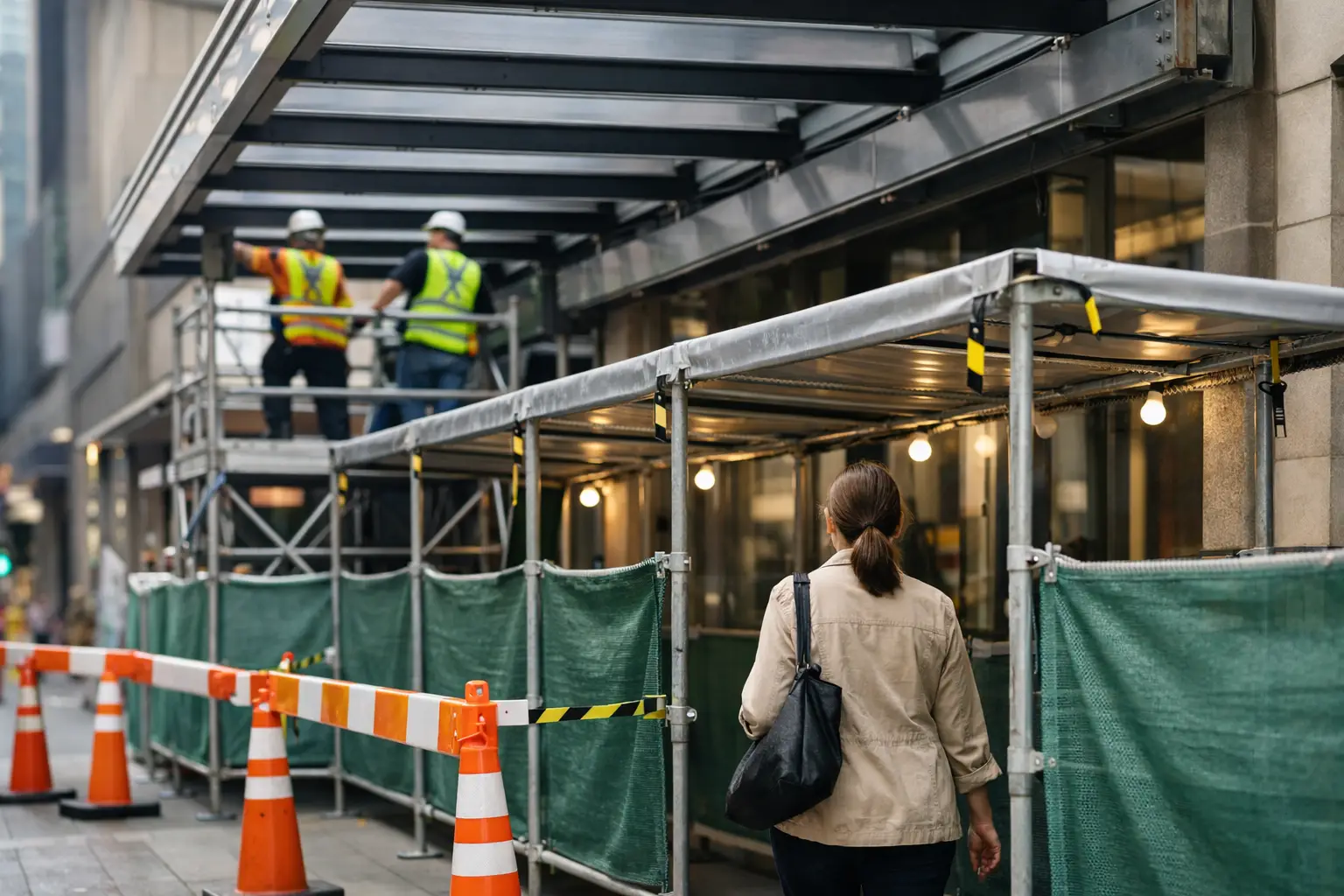
A shop front awning job can put workers above a busy footpath, remove protection from the entrance and create falling-object risks in the same few metres of space. Secure pedestrian access during awning works is therefore not a minor site detail. It is part of planning the job properly, protecting the public and keeping a commercial premises workable while construction is underway.
For landlords, builders and business owners, the goal is simple: people need a clear, safe and understandable way past or into the site. The method will depend on the awning condition, the height of the work, the width of the footpath, trading hours and the local authority requirements. A properly managed access plan avoids rushed decisions once demolition or installation has started.
Start with the real risks at the shop front
Awning works affect pedestrians differently from many internal fit-out jobs. The work is exposed to the public, often directly above entry doors, display windows and public footpaths. A loose sheet, removed fascia section, dropped tool or sudden change in weather can create a serious issue quickly.
The first step is to inspect the awning and its surroundings before work begins. This includes the structure itself, fixings, signs of corrosion, roof sheeting, gutters, electrical items, neighbouring tenancies and the condition of the footpath below. An older awning that is being demolished may need a broader exclusion area than a straightforward replacement, particularly where there is deteriorated material or uncertainty around the original construction.
The public movement around the premises also matters. A quiet industrial frontage can be managed differently from a café on a narrow inner-city footpath during the morning rush. Deliveries, prams, wheelchairs, school traffic, bus stops and neighbouring entrances all need to be considered. If the site cannot safely maintain a route beneath or beside the work, that area needs to be closed and pedestrians redirected in a controlled way.
Planning secure pedestrian access during awning works
The safest arrangement is not always the one that leaves the biggest section of footpath open. It is the one that separates people from the work zone and makes the safe route obvious.
Where work is occurring overhead, a designated exclusion zone is usually required. Its size should reflect the type of work being completed, the potential drop zone and the equipment in use. It must be physically controlled, not just marked with a few cones. Temporary fencing, barricades and solid barriers give pedestrians a clear message that they cannot enter the area.
If a covered pedestrian walkway or gantry is appropriate, it needs to be designed and installed for the actual risk. A makeshift cover is not an answer to overhead work. The protection must be stable, capable of handling the expected loads and positioned so it does not create new hazards such as low head clearance, sharp edges or trip points.
In some cases, the sensible option is to close the footpath section for limited periods and use an approved diversion. This can be inconvenient, but it may be safer than trying to work around constant pedestrian traffic. The right decision depends on the site. Keeping a route open at all costs is not good management if workers are removing old steelwork or lifting new awning components into position.
Keep access clear and accessible
Any temporary path needs to be wide enough, level where practical and free from hoses, leads, tools and rubbish. Loose materials should not be staged on the public side of barriers. If access to a shop entrance is being retained, the path to that entrance must remain clear and easy to understand.
Accessibility should be considered from the beginning, not added as an afterthought. People using wheelchairs, mobility aids, prams or vision assistance need a route that is safe and usable. Sudden narrowed passages, unprotected uneven surfaces and confusing detours can turn a minor construction task into a real obstacle for the public.
Signage helps, but signs alone do not control a hazard. Use clear, visible directions before a pedestrian reaches the closed area, not after they have walked into it. Where a diversion changes during the day, update the signs immediately. A barrier that leads nowhere or directs people into traffic is worse than no sign at all.
Control the work above the footpath
A secure pedestrian route relies on disciplined work practices overhead. Before demolition, repair or installation begins, the crew should know how materials will be removed, lowered, lifted and secured. Nothing should be thrown down, dropped into a skip from height or left unsecured near an edge.
Tools and small components need to be managed as carefully as large awning sheets. Tool lanyards may be suitable for certain tasks, while controlled lifting methods are needed for heavier materials. The work area should be kept tidy throughout the job. Offcuts, old bolts and broken sheeting create risks for workers and pedestrians alike when they are allowed to build up.
Weather can change the plan. Strong winds make handling awning sheets and fascia materials more difficult, while rain can make access equipment and footpaths slippery. If conditions make the task unsafe, stopping work is the correct call. A schedule can be recovered. An injury or public incident has far more serious consequences.
Electrical risks also need attention. Shop front awnings may include lighting, signage, wiring or connections that are not obvious from ground level. These items need to be identified and made safe before removal or repair work begins. A safe pedestrian route is only one part of a safe site - the work itself must be properly controlled.
Coordinate with the people using the premises
Most disruption can be reduced through early communication. A tenant needs to know when the entrance may be temporarily restricted, when noisy demolition is planned and whether deliveries need a different arrangement. Neighbouring operators should also know if the job will affect shared frontage or pedestrian movement near their door.
For a retail or hospitality venue, timing can make a major difference. Work may need to be programmed outside peak trade, before opening or in staged sections to maintain customer access. That is not always possible, especially if an awning is unsafe and requires urgent attention, but it should be discussed openly before the crew arrives.
Property managers should confirm who is responsible for communicating with tenants, arranging any required approvals and dealing with council or traffic management conditions. Requirements can vary based on the location, the footpath layout and whether the works affect a road, parking lane or public asset. Clear responsibilities prevent delays and avoid a situation where trades are on site but cannot safely proceed.
Check barriers and access throughout the day
Pedestrian controls are not a set-and-forget task. Barriers can be moved by customers, deliveries, wind or nearby activity. Signs can fall over, and workers may need to change the work zone as the job progresses. Regular checks are essential, particularly at the start of the shift, after breaks, when materials are delivered and before the site is left unattended.
The supervisor should look at the site from a pedestrian's point of view. Can someone tell where to walk? Is the route blocked by a bin, parked vehicle or loose material? Can a person accidentally step into the exclusion zone? Are children likely to climb or move the barriers? These are practical questions that prevent common site failures.
At the end of each day, the area needs to be left safe and secure. Any partially removed awning elements, exposed fixings, access equipment and materials must be properly managed. If the awning has been removed and the entrance is exposed, temporary weather protection or other measures may be needed until the replacement work is complete.
Use experienced awning contractors for public-facing work
Commercial awning work is not only about making the finished canopy look right. It involves working at height, managing existing structures and protecting people moving through an active public space. Experienced contractors understand that the job starts with site control and finishes only when the frontage is safe, clean and ready for normal use.
Advanced Awnings approaches shop front demolition, repairs and installations with that practical standard in mind. The work should be planned around the structure, the public environment and the needs of the business, with clear communication from quote through to completion.
When an awning needs attention, do not wait until loose material, water damage or visible deterioration forces an urgent response. A site inspection and straightforward plan for access, safety and repair can keep the footpath moving and give everyone around the premises confidence that the work is being done properly.