
Commercial Awning Handover Checklist for Sydney
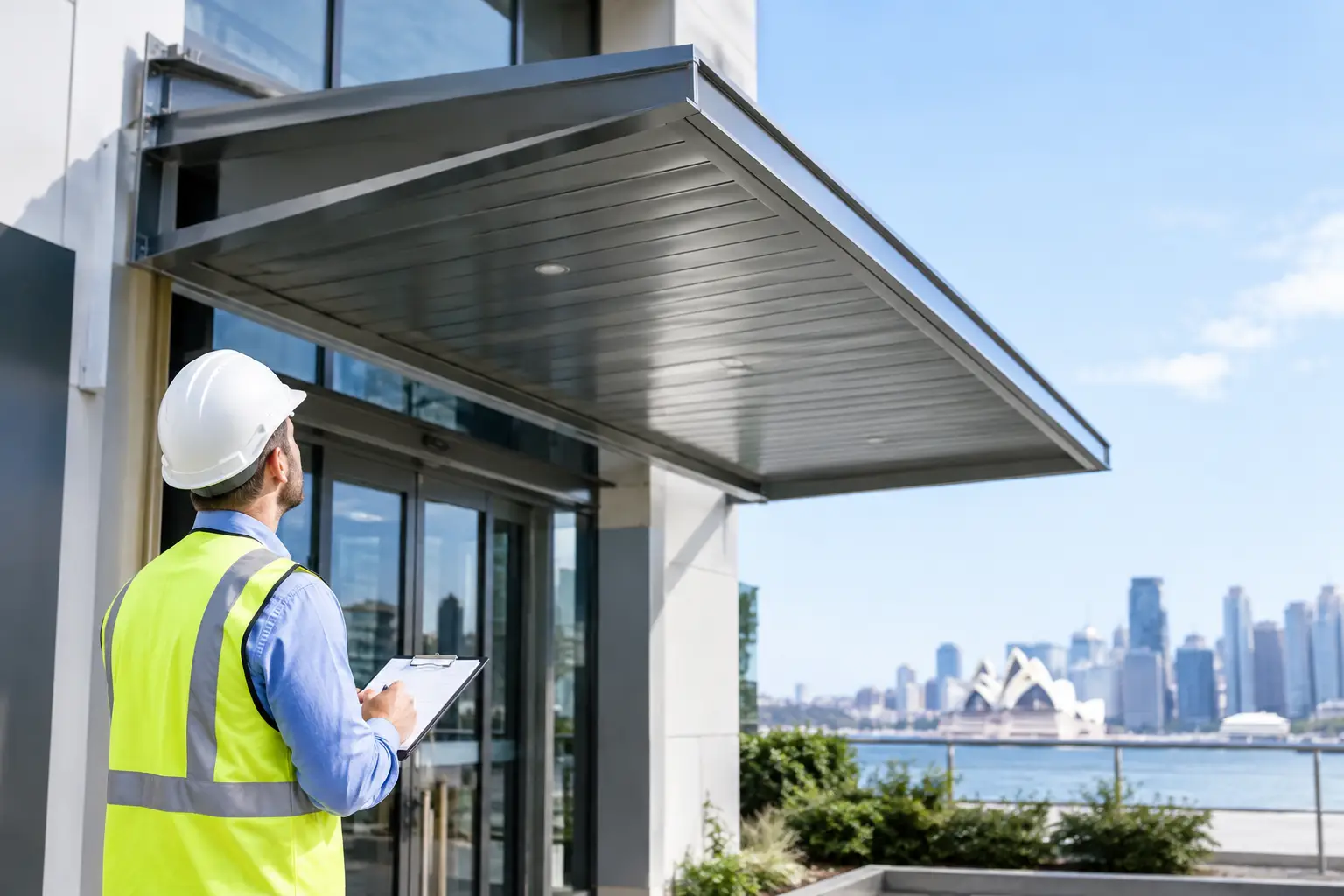
A new shop front awning can look finished from the footpath while key handover details are still missing. Before the site is signed off, a proper commercial awning handover checklist confirms the structure is safe, the finish is up to standard, documentation is in order and the person responsible for the premises knows what to inspect going forward.
For landlords, builders, retailers and hospitality operators, this final stage is not paperwork for paperwork’s sake. It is the point where the installed awning becomes an asset you are responsible for maintaining. Taking the time to inspect it properly can prevent disputes, avoidable repairs and safety issues over a public footpath.
Start with the Site and Safety Setup
Handover should happen after the work area has been cleared, not while tools, offcuts or access equipment are still around the frontage. The footpath, entry and immediate area should be clean, safe and open for normal use unless an agreed restriction remains in place.
Walk the site with the contractor where possible. Look up from the footpath as well as underneath the awning. A street-facing structure has to work from both angles: it needs to present well to customers and sit securely above staff, pedestrians and neighbouring premises.
Check that all temporary barriers, warning signs and protective materials have been removed. Any damage to glazing, cladding, paving, paintwork or signage should be identified before the crew leaves site. Small issues are much easier to resolve when everyone is there and the work is fresh.
If the project involved demolition of an older awning, confirm that all redundant brackets, fixings and materials have been removed or made safe. Nothing should be left that could corrode, loosen or create a future problem behind cladding or along the shop front.
Commercial Awning Handover Checklist: Structure and Finish
The main inspection should be practical. You do not need to be an awning contractor to spot incomplete work, poor alignment or obvious damage. What matters is checking the finished installation against the approved scope, drawings and quotation.
Use the following points as a working checklist during handover:
- Alignment and set-out: Check the awning sits level, follows the intended line of the building and is positioned correctly over the shop front, doors and windows. Fascias, gutters and lining should look straight when viewed from the street.
- Fixings and connections: Confirm bolts, brackets, flashings and connection points are properly finished and protected. There should be no loose components, sharp edges, exposed unfinished steel or obvious gaps around penetrations.
- Water management: Look at gutters, downpipes, flashings and roof junctions. Water should be directed away from entries, walls and pedestrian areas. If practical, ask how the system has been checked for drainage.
- Roof sheeting and cladding: Sheets should be secure, consistent in colour and free from dents, swarf, scratches or poorly cut edges. Check that overlaps and flashings are neat and suitable for the exposure of the site.
- Ceiling and underside finish: Where the awning has a soffit, lining or ceiling, inspect for straight lines, clean joins, secure panels and access to any agreed services. This is the surface customers see most often.
- Signage, lighting and services: If signs, lights, wiring, security devices or cameras are attached to or run through the awning, confirm they are fitted as agreed and operating correctly. Electrical work should be handed over with the relevant electrical documentation from the licenced contractor.
- Paint and corrosion protection: Check that painted steelwork, sealed edges and touch-ups are complete. This is particularly relevant on older buildings, coastal locations and awnings exposed to regular wash-down or weather.
A few minor cosmetic touch-ups may be reasonable at practical completion, but they should be recorded clearly with an agreed timeframe. Do not assume a verbal comment will be remembered once the site has been packed up.
Confirm Compliance Documents and Approvals
The documents required at handover depend on the type of awning, its size, how it is fixed to the building and the approval pathway used for the project. A straightforward replacement does not always carry the same requirements as a new structural shop front awning or a major alteration to an existing façade.
Ask for the documents that apply to your job. These may include approved plans, engineering details or certification, relevant warranties, material information and records for associated electrical work. If a certifier, council, building manager or strata manager was involved, make sure their required inspections or sign-offs have been completed before the project is treated as finished.
Engineering certification deserves particular attention. Where the awning has been designed or certified by an engineer, retain the final documentation with the building records. A future tenant, property manager, insurer or contractor may need it when planning signage, repairs, façade works or changes to the tenancy.
It is also worth keeping copies of the original quotation and any approved variations together. They show what was included, what was changed on site and which parts of the awning or associated works remain under warranty.
Test What Can Be Tested Before Sign-Off
Not every fault is visible in a static inspection. Doors should open without catching on new fascias or downpipes. Lighting should operate. Drainage should be understood. If rain is expected soon after completion, arrange a follow-up inspection if there is any concern about runoff, overflow or water entering at the wall connection.
For retractable or mechanically operated awnings, the handover needs to include operation rather than just appearance. Run the system through its full movement, check controls and safety functions, and make sure the site representative understands wind limitations, manual override arrangements and basic care requirements.
Fixed shop front awnings have fewer moving parts, but they still need a clear explanation of access and maintenance. Ask how gutters can be cleaned safely and whether there are areas that should not be loaded, drilled into or used to support additional signage. An awning is not automatically designed to carry every future fitting a tenant may want to add.
Record Defects Properly
A defects list is not a sign that the job has failed. It is a normal way to close out small items properly. The key is being specific. Rather than noting poor finish near entry, record the location, the issue and the agreed action, such as touch up paint to lower fascia beside main entry door.
Take dated photos during the inspection, including wide shots of the full frontage and close-ups of any items needing attention. This creates a simple record of the finished condition and helps if questions arise later about damage, maintenance or third-party work.
Agree on who will arrange access if rectification is needed. For active shops, cafés and venues, this matters. A return visit may need to happen before opening, after closing or during a quieter trade period so the work does not disrupt customers or create a hazard at the entrance.
Set Up a Sensible Maintenance Plan
Commercial awnings are exposed to wind, rain, sun, pollution, tree debris and occasional impact from delivery vehicles or contractors. A well-built awning will last longer when minor issues are dealt with early.
The person responsible for the building should carry out visual checks from ground level after severe weather and at regular intervals. Look for blocked gutters, staining, loose lining panels, rust marks, damaged sheeting, water leaks and movement around fixings. Do not climb onto the awning or attempt high-level repairs without safe access and the right contractor.
Maintenance frequency depends on location and exposure. A busy Sydney street with trees overhead, salt air nearby or regular food-service exhaust may need more attention than a protected suburban frontage. Cleaning should be done with methods suitable for the finish, particularly painted metal, powder-coated components and translucent roof materials.
If damage is found, act before it spreads. A small leak at flashing can become damaged internal linings. A loose fascia can become a public safety issue. Early repair is usually simpler, safer and less expensive than waiting for a visible failure.
Make Handover the Start of a Well-Maintained Asset
A signed handover should leave you with more than a good-looking frontage. You should know what has been installed, what documents to keep, what needs routine attention and who to call if something changes. That is the practical value of doing the final inspection carefully.
For commercial property, the best handovers are straightforward: the work is complete, the site is clean, the records are clear and the awning is ready to do its job over the long term.