Five Commercial Awning Safety Checks for Shopfronts
A shopfront awning sits over customers, staff and pedestrians every day. That makes it more than a signboard or a way to keep rain off the doorway. These five commercial awning safety checks give owners, landlords and property managers a practical way to spot problems early, before a small repair turns into a public safety issue, a damaged façade or an unplanned closure.
A visual check does not replace an engineer’s assessment or professional repair work. It does, however, help the person responsible for the premises recognise when something has changed and act before the awning becomes unsafe.
Why commercial awning checks should be routine
Commercial awnings work hard in Sydney conditions. They carry their own weight, signage, lighting and sometimes rainwater, while being exposed to wind, heat, traffic grime and salt air in coastal areas. On busy streets, they are also vulnerable to impact from delivery vehicles, ladders, building works and poor alterations made over the years.
The difficult part is that structural issues are not always obvious from ground level. Rust can develop behind fascia panels. Water can enter around flashings and travel along steel members. A loose fixing may only show itself when the wind picks up. Regular inspections, especially after severe weather or nearby construction, make these issues easier and cheaper to deal with.
Five commercial awning safety checks
1. Look for corrosion, rust stains and damaged steel
Start with the frame, brackets, posts, gutters and visible steel connections. Surface rust is not automatically a structural failure, but it should not be ignored. Flaking paint, blistering coatings, deep pitting, orange staining running down the fascia, or steel that looks swollen around joints can all indicate moisture has reached the metal beneath.
Pay close attention to areas where water sits or is trapped: gutter lines, junctions with the building wall, bolt holes, folds in sheet metal and the back of the awning where it meets the façade. On older shopfronts, the condition behind cladding can be worse than what is visible from the street.
The right response depends on the extent of the corrosion. A localised coating failure may be repaired and repainted once the cause of moisture is addressed. Corrosion around load-bearing brackets, supporting members or connections needs a specialist inspection. Covering rust with paint without checking the steel below is not a repair.
2. Check fixings, brackets and the wall connection
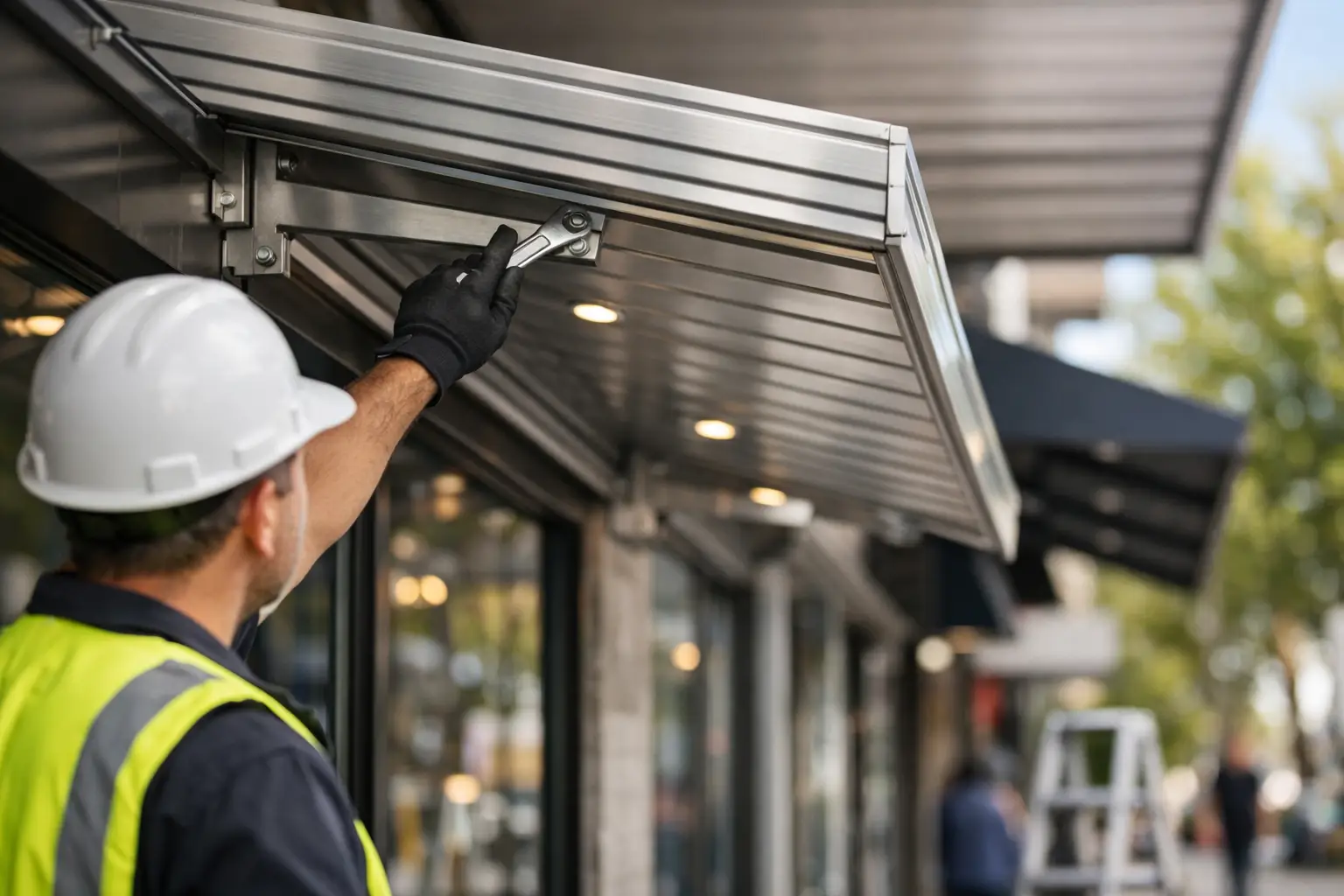
The most critical part of many cantilevered awnings is where the structure connects back to the building. Look for loose or missing bolts, cracked welds, movement around brackets, gaps opening between the awning and wall, or fresh cracks in render, brickwork or cladding near the fixing points.
Do not try to tighten structural bolts without knowing the awning’s design and the condition of the substrate. A fixing may be attached to masonry, structural steel, concrete or a concealed support arrangement. If a bolt is pulling out, the issue may be larger than the bolt itself.
A useful ground-level check is to stand back from the shopfront and look along the awning line. Sagging, a noticeable lean, uneven gaps, or a section sitting lower than the rest deserves attention. It is also worth asking staff whether they have heard rattling, banging or creaking during high winds. Those reports can point to movement that is not obvious on a calm day.
3. Inspect the roof, flashings and drainage path
Water is one of the main causes of commercial awning deterioration. A blocked gutter or failed flashing can allow water to pool on the roof, leak into the tenancy, stain the façade and accelerate corrosion in concealed sections of the frame.
From a safe position, check whether gutters are holding leaves, litter or sediment. Look for overflowing water marks after rain, sagging gutter sections, loose downpipes and water discharging across the footpath. Water should be directed away from entrances and pedestrian areas, not allowed to create a slip hazard at the front door.
Leaks at the wall connection are often mistaken for a roofing problem. In many cases, the flashing that seals the awning to the building has lifted, split or been disturbed by other works. If water is appearing inside the tenancy, do not assume a silicone patch will solve it. The repair needs to address the actual entry point and confirm that trapped moisture has not damaged the supporting structure.
4. Check the fascia, signage, lights and attached items
An awning often carries more than its original structure was designed for. Replacement signs, illuminated lettering, security cameras, banners, hanging planters and temporary decorations can add weight or create wind loads. Even a small item becomes a risk if its mounting point fails over a public footpath.
Look for loose fascia sheets, missing rivets or screws, sharp edges, cracked panels and sections that move in the wind. Check that signs and lights are securely fixed and that electrical cables are protected, properly supported and not exposed to water. If a sign has been added since the awning was installed, it is worth confirming that the support arrangement is suitable for the extra load.
Temporary fixes are common on active retail sites, particularly when a panel starts rattling or a sign needs to be reinstated quickly. They should remain temporary. Self-drilling screws, tape, cable ties or makeshift brackets may hold something in place for a short period, but they are not a substitute for a properly assessed repair.
5. Check for movement, impact damage and changed conditions
The final check is about what has changed around the awning. Look for dents, bent posts, torn roof sheeting, damaged corners and fresh scrapes that could have been caused by a delivery truck, cherry picker or construction equipment. A minor-looking impact can transfer force back to a bracket or connection point.
Also consider changes to the building and site. Have new air-conditioning units, signage, solar work, cladding or services been installed nearby? Has a neighbouring demolition or excavation caused vibration? Has drainage been altered? These works can affect flashings, fixings and the way water moves around the structure.
Wind damage needs particular care. After a major storm, inspect the awning from ground level before reopening the area beneath it. If there is visible movement, loose material, sagging, water pooling or debris caught on the roof, keep people clear and arrange a professional assessment. Do not send staff onto an awning roof or use a ladder in poor conditions to investigate.
Set a sensible inspection routine
For most commercial premises, a visual check every few months is a sensible starting point, with extra checks after severe weather, impact incidents or nearby building work. The frequency should increase for older awnings, coastal locations, busy loading areas and structures with large signs or complex drainage.
Keep a simple record with the date, photographs and notes on anything unusual. This gives a property manager or contractor a clearer picture of whether a crack, rust patch or alignment issue is getting worse. It also helps prevent maintenance concerns being lost when tenancies or site managers change.
If access is required, use the right equipment and people. Commercial awnings are not designed as general work platforms unless they have been specifically engineered for that purpose. Roof access, elevated work and structural repairs should be planned properly, with public areas managed below.
When a repair becomes a safety matter
Some warning signs should be treated as urgent: a visible sag or lean, movement at the wall connection, loose cladding over a footpath, severe corrosion around brackets, falling debris, electrical damage, or water entering near structural fixings. Restrict access beneath the affected section where practical and contact a qualified commercial awning contractor.
There is a difference between maintaining an awning and simply making it look tidy. A quality repair identifies why the damage occurred, deals with the structural or water-management issue, and restores the finish so the shopfront remains safe and presentable. Where required, engineer’s certification can provide the right level of assurance for replacement, alteration or compliance work.
A well-maintained awning protects the people below it and preserves the appearance of the business behind it. If something does not look right, trust that observation and have it checked while the solution is still straightforward.