Commercial Canopy Demolition Guide for Sydney Sites
A commercial canopy can look straightforward from street level, but removing one is rarely a simple unbolt-and-lower job. This commercial canopy demolition guide explains what property owners, builders and shop operators need to consider before work starts, particularly where a canopy sits above a busy footpath, shop entry or trading area.
The priority is not just getting the old structure down. It is protecting pedestrians, preventing damage to the building, keeping the site controlled and leaving a sound base for repairs or a replacement shopfront awning. The right demolition plan saves time later and avoids the costly surprises that tend to appear once old sheeting, flashing and brackets come off.
Start with the canopy, not the quote
A proper inspection should identify what the canopy is made from, how it is fixed and what condition the supporting structure is in. Older commercial awnings may include steel framing, timber members, aluminium cladding, corrugated sheeting, polycarbonate, glazed panels or combinations of several materials. The visible fascia does not always tell the full story.
The key question is where the load goes. Some canopies are tied back into the façade, while others rely on posts, cantilevered steelwork, suspended rods or framing connected through the building structure. Corrosion around bolts, water damage behind flashing and altered shopfronts can all change the safest removal method.
This is why a visual check from the ground is not enough. Before demolition, an experienced contractor will assess access, fixing points, roof connections, drainage, electrical items and the condition of the wall behind the canopy. If there are signs of movement, severe rust, failed brackets or damage to the façade, engineering advice may be required before the structure is disturbed.
Confirm approvals and site responsibilities
Demolition work on a street-facing canopy can affect more than the tenancy beneath it. It may involve the building owner, managing agent, tenant, builder, strata manager, council requirements and neighbouring businesses. Get responsibilities clear before crews arrive.
Depending on the size, location and scope of the work, approvals, permits or notifications may be needed. Work that occupies a footpath, affects a road lane, uses elevated access equipment or requires a pedestrian diversion generally needs careful coordination with the relevant authorities. Requirements vary by council area and site conditions, so assumptions are a poor substitute for checking early.
If the canopy forms part of a larger façade alteration or replacement project, confirm whether plans, certification or engineering documentation are needed for the new work as well. Removing an unsafe structure may be urgent, but the replacement still needs to suit the building, comply with applicable requirements and be properly fixed.
For occupied retail and hospitality sites, agree on practical details in writing. These include trading hours, customer access, delivery arrangements, noise limits, signage removal, temporary weather protection and who is responsible for securing the premises at the end of each shift.
Public safety comes before speed
Street-front demolition is different from work at the rear of an industrial site. Customers, pedestrians, parked vehicles, delivery drivers and neighbouring tenants may be directly below or beside the work zone. A canopy can also contain loose cladding or unstable sections that become hazardous once fasteners are removed.
A suitable site-specific safety plan should set out how the area will be isolated, how people will be directed around the work and how falling-object risks will be controlled. The work zone may need barriers, exclusion areas, warning signs, overhead protection or a managed pedestrian diversion. Where plant, lifting gear or a crane is required, access and lifting arrangements need to be planned around the actual street conditions.
Do not accept a plan that relies on someone simply watching the footpath while pieces are removed overhead. Spotters have a role, but physical controls and a controlled exclusion zone are far more reliable. The public should not be walking beneath active demolition work.
Weather also matters. Wind can turn lightweight canopy sheets into dangerous sails, while rain can make roof access and steelwork slippery. A competent crew knows when conditions are unsuitable and will stop rather than push through a risky stage of the job.
Check for hidden services and hazardous materials
Canopies often carry more than shade. Lighting, illuminated signage, security cameras, power cables, data lines, downpipes and stormwater connections may run through or beside the structure. These services must be identified and safely isolated by the appropriate trades before demolition begins.
Older premises need particular care. Fibro cement sheeting, backing boards, eaves, adhesives and insulation may contain hazardous materials, including asbestos. Age alone does not confirm what a material is, and guessing is not a safe approach. If suspect material is present, it should be assessed and managed in line with the required process before general demolition proceeds.
Lead paint and sharp, rusted steel are other common concerns on ageing shopfronts. Removing material without a containment and disposal plan can expose workers, tenants and the public to unnecessary risk. Rubbish should be sorted where practical, contained securely and removed from site without blocking access or leaving hazards behind.
Commercial canopy demolition guide: the removal sequence
The removal sequence depends on the canopy design, but the principle stays the same: take the load off in a controlled order and never remove supports blindly. The crew should understand which components are decorative, which are secondary framing and which are carrying the actual load.
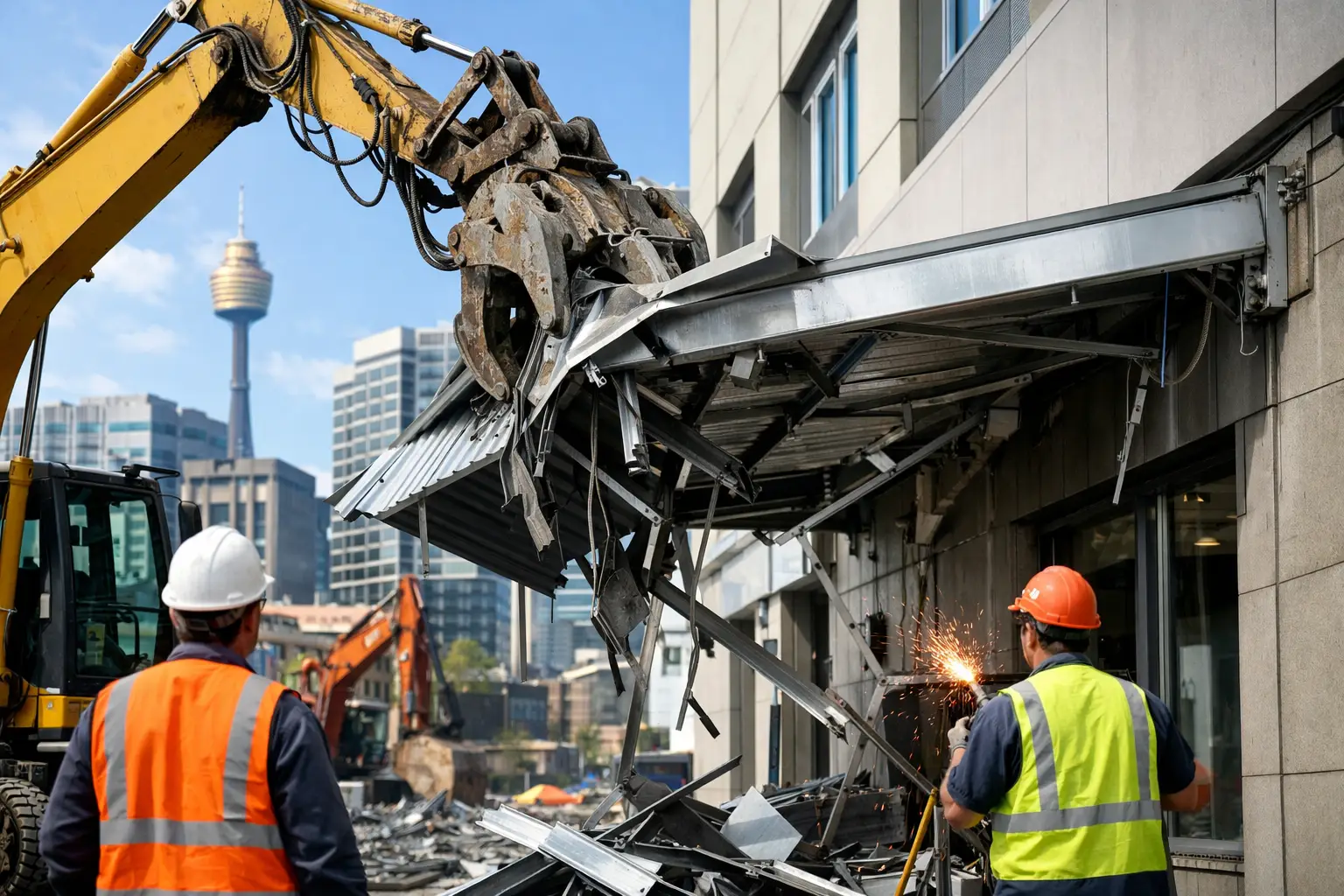
Work commonly starts with isolating services and removing signs, light fittings, loose cladding and non-structural fascia elements. This gives clear access to the frame and reveals any concealed corrosion or damage. The structure can then be supported as required before primary members, posts, rods or brackets are disconnected.
Large components should be lowered under control, not dropped or pushed from height. Depending on access, this may involve elevated work platforms, lifting equipment, temporary supports or manual handling by a suitably sized crew. The method should suit the structure and site, not whatever equipment happens to be available that day.
Once the canopy is down, the job is not finished. Old bolts, damaged flashing, open penetrations and rough steel stubs need to be addressed. Any holes or exposed areas in the façade should be made weather-tight, and the shopfront should be left safe for staff, customers and the next trade.
Prepare properly for replacement work
Demolition is often the first stage of installing a new commercial awning. That makes the condition of the building after removal especially important. A replacement cannot be installed properly over deteriorated substrate, hidden water damage or poorly repaired fixings.
Ask the contractor to inspect the exposed wall and connection points once the old structure is removed. This is when issues such as rotten timber, cracked masonry, rusted steel lintels, failed waterproofing and inadequate fixing locations are easiest to identify. It can add work to the scope, but dealing with it now is usually better than covering it up and facing another failure later.
A well-planned replacement also considers drainage, head clearance, signage, lighting, wind exposure and the appearance of the full shopfront. The cheapest canopy design is not always the best value if it creates water run-off problems, looks undersized or requires ongoing repairs.
Choosing the right demolition contractor
For commercial canopy removal, choose a contractor with experience in shopfront awnings rather than a general crew that treats the structure as simple scrap metal. Ask how they will control pedestrian access, isolate services, manage waste, protect the façade and respond if hidden defects are found.
You should also confirm that the contractor is appropriately insured, provides clear scope details and can coordinate with engineers or other trades where needed. A low quote that excludes permits, traffic management, access equipment, making-good work or rubbish removal can quickly become the expensive option.
Advanced Awnings approaches demolition as part of the full shopfront outcome, whether the site needs a safe removal, repairs to the existing structure or a properly planned replacement canopy.
The best time to solve access, safety and structural issues is before the first bolt is removed. A clear site inspection and an honest scope give everyone - owner, tenant, builder and contractor - a better chance of getting the work done safely and leaving the frontage ready for what comes next.