Commercial Canopy Drainage Guide for Sydney Sites
A canopy can look sound from the street while hiding a drainage problem above it. Water that ponds on a commercial awning, runs behind a fascia or spills over a busy footpath can damage the shopfront, create slip hazards and shorten the life of the structure. This commercial canopy drainage guide covers the practical checks that help property owners and operators deal with water properly before a small issue becomes an expensive repair.
Why canopy drainage needs proper attention
Commercial canopies sit in an exposed position. They collect rain from their own roof area and, in some cases, water flowing from the building above. When that water is not directed into a suitable drainage path, it finds the next available route: over the front edge, into wall cladding, through ceiling joins or down the face of the shop.
The consequences are rarely limited to a wet patch. Ongoing moisture can stain fascias, corrode steelwork, swell timber components, loosen fixings and cause paint failure. Water entering the wall behind the canopy may not be visible until internal linings, electrical fittings or signage have already been affected.
For street-facing premises, public safety is just as important. Overflowing gutters and poorly positioned outlets can drop water onto pedestrians at the entrance. On a hospitality site, that can mean wet outdoor areas, complaints from customers and a hazard that staff must manage during every heavy shower.
A drainage solution needs to work in real weather, not only when a hose is run over the roof for five minutes.
Start by tracing the water path
The first job is to establish where water lands, where it travels and where it discharges. This sounds simple, but commercial canopy drainage often involves more than one roof surface, hidden flashings and existing building stormwater that may have been altered over time.
Inspect the canopy during rain where it is safe to do so, or look for clear evidence after a downpour. Ponding marks, rust lines, stained joints, drips at the underside and overflowing gutters all show where the system is struggling. Ask staff when leaks occur. A leak that appears only during wind-driven rain may point to flashing or wall junctions rather than gutter capacity.
The intended path should be clear: water falls onto the canopy, moves across the roof at the designed fall, enters a gutter or internal collection point, travels through downpipes and discharges into an approved stormwater connection or a controlled drainage area. If any part of that path is blocked, undersized, damaged or missing, water will back up.
Do not assume the nearest downpipe is connected or working. Downpipes can be blocked with leaves, disconnected during previous building work or terminated into a section of drainage that cannot cope with the flow.
Fall, gutter size and outlet position
A canopy roof needs enough fall to move water to its collection point. Flat-looking commercial awnings are not always completely flat, but very low falls demand careful detailing. Even a small dip caused by settlement, impact damage or poor support can hold water after rain.
Standing water adds weight and keeps moisture against roof sheeting, sealants and fasteners. On older canopies, it may also reveal that the supporting frame has moved or deteriorated. Simply cleaning the gutter will not fix a roof that has lost its fall.
Gutter capacity is the next issue. A narrow box gutter may handle normal showers but overflow in a heavy Sydney storm, particularly when leaves or roof debris reduce the effective opening. The size, depth and number of outlets need to suit the catchment area and the way water arrives at the canopy. A wide shopfront canopy that receives runoff from an upper roof needs more consideration than a small entry awning with an independent roof.
Outlet placement matters as much as gutter size. Water should not have to travel too far through a shallow gutter before reaching a downpipe. If it does, the gutter can surcharge at the far end and spill over the front fascia. In some cases, adding or relocating outlets is more effective than making cosmetic repairs to recurring overflow damage.
Check the junction where canopy meets building
The wall connection is one of the most common leak points on a commercial canopy. Water can enter behind the roof sheet when flashing is too short, poorly lapped, cracked or sealed with failing silicone. It can also track through penetrations for signs, lighting, air-conditioning pipework or old brackets.
A proper detail relies on formed flashings, correct laps and a secure connection to the building. Sealant has a role, but it should not be the only thing preventing water from entering a wall junction. Sealant ages, moves and eventually breaks down under sun and weather.
This is where repair work needs sound judgement. Reapplying sealant may be suitable for a small, accessible gap where the flashing is otherwise sound. If the flashing is incorrectly installed, the canopy roof has been altered or water has been entering for some time, sections may need to be removed and rebuilt properly.
Look underneath as well. Brown staining, bubbling paint, mould, sagging linings or corrosion around fixings can indicate water entering above. The visible drip point is not always where the water started.
Keep downpipes clear and protected
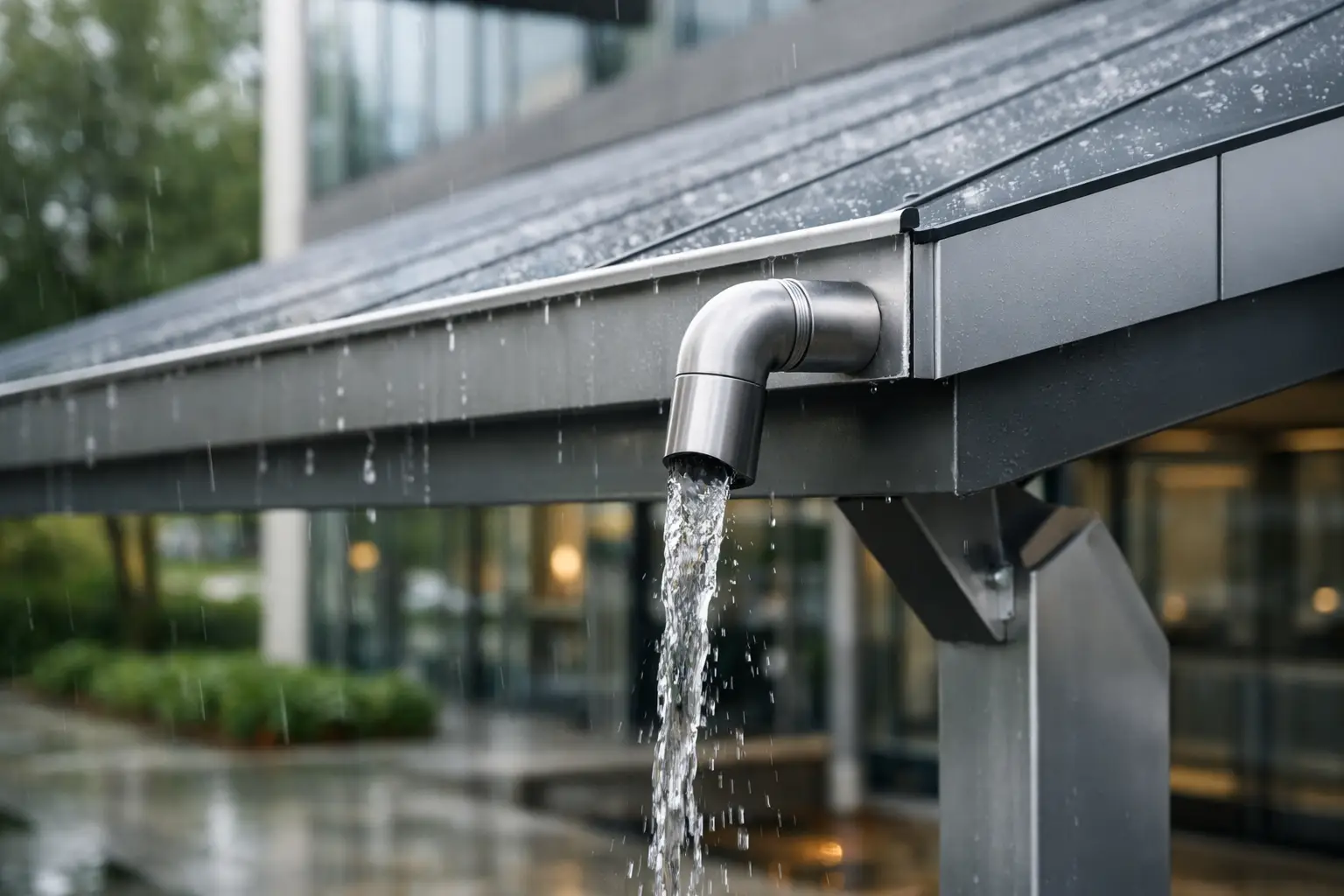
Downpipes are often treated as an afterthought, yet they carry the entire drainage load away from the canopy. They should be securely fixed, protected from damage in high-traffic areas and positioned so discharge does not create a problem at the front door or on the footpath.
Where a downpipe is exposed near deliveries, bins or outdoor seating, it may need guards or a more protected route. A dented downpipe can restrict flow substantially. So can a build-up of leaves at the gutter outlet, especially under trees or near upper-level balconies.
Routine maintenance should include clearing gutters and outlets, checking brackets and looking for corrosion at joins. The required frequency depends on the site. A clean, sheltered arcade may need little attention, while a leafy high street location can need inspections before and through the wetter months.
If water discharges at ground level, make sure it is directed to an appropriate drainage point rather than across a pedestrian path. A temporary hose extension or open outlet might solve an immediate problem, but it is not a long-term answer for an active commercial frontage.
Repairs, replacement or a redesigned drainage layout?
The right scope depends on the cause and condition of the canopy. Minor repairs can be worthwhile where the structure is sound and the problem is isolated, such as a blocked outlet, damaged downpipe section, failed gutter joint or small flashing defect.
Replacement becomes the more sensible option when corrosion is widespread, the canopy has poor falls, roof sheets and gutters have reached the end of their service life, or repeated patch repairs are no longer holding. Rebuilding also gives the opportunity to correct drainage details that were wrong from the start, including gutter depth, outlet numbers and downpipe placement.
For larger commercial awnings, particularly those connected to older buildings or located over public areas, drainage work may need to be considered alongside structural condition, existing services and access requirements. Any demolition, lifting or replacement should be planned so the site remains safe for workers, customers and passers-by.
Where engineer certification or specific approvals are required, deal with that early. It avoids designing a new canopy around assumptions that do not suit the building, drainage connection or compliance requirements.
A practical inspection checklist
A straightforward inspection after heavy rain can reveal most early warning signs. Check whether water is pooling on the roof, spilling over the fascia, dripping from the underside or entering at the wall connection. Inspect gutters for leaves and sediment, then confirm downpipes are intact, firmly fixed and carrying water away.
Also look for rust, staining, loose sheet edges, cracked sealant, deteriorated flashing and changes in roof level. Take photos from a safe position and keep a record of when the issue occurs. This helps separate a one-off blockage from a drainage design fault.
Avoid climbing onto a canopy without suitable access and safety controls. Commercial awnings can have fragile sheeting, concealed damage and edges exposed to the public below. A professional inspection is the safer option when the source cannot be seen from ground level or when water is affecting structural components.
Get the detail right before the next storm
Good canopy drainage is not a decorative extra. It protects the awning, the building behind it and the people walking beneath it. For property managers and business owners, the best time to inspect is before recurring overflow, ceiling damage or a slippery entry forces an urgent repair.
If a canopy is leaking, ponding or discharging where it should not, have the full water path checked rather than patching the most obvious drip. Advanced Awnings can assess commercial awning condition, repair damaged drainage components or plan replacement work with the practical site conditions in mind. A properly built canopy should keep doing its job when the weather turns, without creating another problem at the shopfront.